
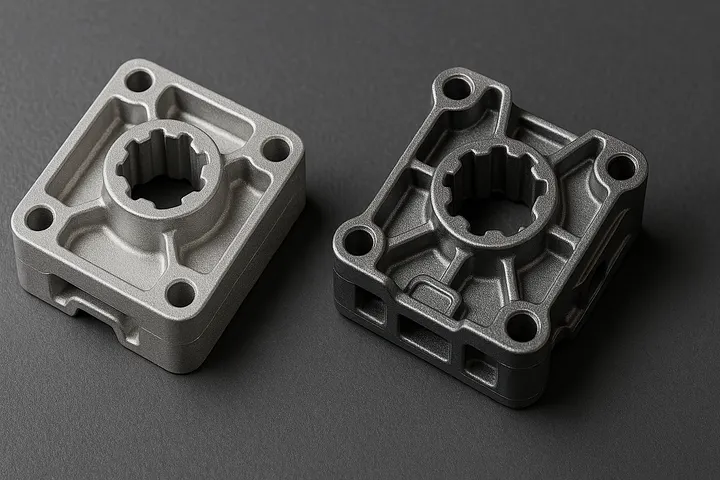
Your product has successfully navigated the demanding gauntlet of research, design, and prototyping. It has been tested, validated, and is now ready to make the momentous leap into mass production. You have determined that a metal component is essential for its strength, durability, and premium feel. Now, you stand at one of the most pivotal crossroads in the manufacturing journey: selecting the right alloy.
In the vast world of non-ferrous metals, two champions dominate the landscape of die casting, the go-to process for high-volume, complex metal parts: Aluminum and Zinc.
Both are exceptional materials, each responsible for billions of high-performing components across every conceivable industry. Both offer excellent castability, good mechanical properties, and a superb return on investment at scale. But this is where the similarities end. Beneath the surface, aluminum and zinc are fundamentally different alloys, engineered to serve different masters. Choosing the wrong one for your application can lead to compromised performance, unnecessary weight, higher long-term costs, and a final product that fails to meet your aesthetic vision.
So, how do you choose? When does the lightweight prowess of Aluminum win out? And when does the intricate precision of Zinc take the crown?
As a leader in precision die casting and metal manufacturing, we at IDMockup have guided countless clients through this critical decision. It is not a simple question of which is “better,” but a strategic analysis of which is the optimal fit for your product, your production volume, your budget, and your brand. This comprehensive guide will break down the comparison into four key rounds, giving you the strategic insights needed to make the perfect choice for your project.
Chapter 1: Meet the Contenders — A Tale of Two Alloys
Before we dive into a head-to-head comparison, let’s get to know our two contenders and their unique personalities.
Aluminum Alloys (The Lightweight Champion)
When you think of aluminum, think of agility, performance, and efficiency. It is the undisputed champion of strength-to-weight ratio. This single characteristic has made it the indispensable material for industries where reducing mass is a critical mission, from aerospace and automotive to performance sports equipment and portable electronics. Beyond its lightness, aluminum boasts excellent corrosion resistance, is a brilliant thermal conductor (making it ideal for heatsinks), and can be given a unique, durable, and colorful finish through anodizing. It is the modern, versatile workhorse of the metal world.
Zinc Alloys (The Precision Heavyweight)
When you think of zinc, think of substance, detail, and flawless finish. Zinc is the precision artist of the die-casting world. It is significantly denser than aluminum, giving parts a substantial, high-quality heft. Its true superpower, however, lies in its material properties during casting. With a much lower melting point and incredible fluidity, it can be cast into extraordinarily complex and intricate shapes with a level of detail that other metals struggle to match. Furthermore, it is the ideal base metal for achieving a brilliant, mirror-like electroplated finish, making it the top choice for high-end decorative hardware, premium automotive emblems, and components that demand a flawless cosmetic surface.
Chapter 2: The Four-Round Bout — Deciding the Winner for Your Project
Let’s put these two champions in the ring and see how they stack up across the four factors that should drive your decision.
Round 1: Precision, Complexity & Thin-Wall Capability
The first round is a test of finesse. How well can the material replicate the most intricate details of your design directly from the mold?
Zinc’s Knockout Punch: This is where Zinc immediately establishes its dominance. Zinc alloys have a much lower melting point (around 420°C / 788°F) and a significantly higher density and fluidity compared to aluminum. This combination is its superpower. In its molten state, it flows like water into the steel die, filling every microscopic crevice, sharp corner, and delicate feature with ease.
Implications: This allows Zinc to produce “net-shape” or “near-net-shape” parts. This means the component comes out of the mold so detailed and precise that it often requires little to no secondary machining. More importantly, Zinc excels at creating parts with incredibly thin walls, reliably achieving thicknesses as low as 0.25mm.
Aluminum’s Performance: Aluminum has a higher melting point (around 660°C / 1220°F) and is more viscous in its molten state. It requires much higher pressures to force it into the die. While it is excellent at producing strong, stable, structural shapes, it struggles to fill the ultra-thin sections that Zinc handles with ease. Capturing the same level of fine, crisp detail (like sharp-edged text or complex textures) is also more challenging. While it produces near-net-shape parts, it is more likely to require secondary CNC machining to achieve its final, critical tolerances.
The Verdict & Decision Guide:
- Choose ZINC when your product’s absolute priority is achieving the highest level of detail. If your design features intricate geometries, complex textures, razor-sharp lettering, or requires walls of 1mm or less, Zinc is the superior choice. It will deliver a more precise part directly from the tool, minimizing the need for costly secondary operations.
Round 2: Performance, Strength & Weight
This round is a test of pure athletics. How does the material perform under stress, and what is the trade-off with its mass?
Aluminum’s Key Advantage: This is Aluminum’s home turf. Its standout characteristic is its phenomenal strength-to-weight ratio. While a part made of zinc may be harder and stronger in a direct, absolute comparison, an aluminum part will provide more strength for its given weight. The density of common die-casting aluminum alloys is around 2.7 g/cm³.
Implications: This makes aluminum the automatic, non-negotiable choice for any application where minimizing weight is a primary design goal. This includes virtually all aerospace and automotive structural components, portable electronic device housings, and any part that moves or needs to be lifted.
Zinc’s Performance: Zinc is a dense, heavy alloy, with a density of around 6.7 g/cm³-nearly 2.5 times heavier than aluminum. In applications where light weight is desired, this is a clear disadvantage. However, in many contexts, this heft is a deliberate design feature. The substantial weight of a zinc component can convey a powerful sense of high quality, durability, and value to the user. A solid, heavy handle or knob simply feels more premium than a lightweight one. Zinc also offers excellent hardness and wear resistance.
The Verdict & Decision Guide:
- Choose ALUMINUM when light weight is a critical design requirement for performance, portability, or efficiency.
- Choose ZINC when weight is not a primary concern, and a heavier, more substantial feel is actively desired to enhance the user’s perception of quality and durability.
Round 3: Production, Tooling Life & Overall Cost
This round looks beyond the part itself and into the long-term economics of production. This is where a hidden factor can dramatically influence your total cost of ownership.
Zinc’s Hidden Economic Advantage: This is one of the most crucial, yet often overlooked, differences. The low melting point of Zinc is much kinder and gentler on the hardened steel molds used in die casting compared to the intense heat of molten aluminum.
Implications for Tooling Life: A high-quality steel die used for casting Zinc can often last for over a million cycles before requiring major refurbishment. The very same die used for casting Aluminum might only last for 100,000 to 150,000 cycles before the high heat begins to cause erosion and heat checking (micro-cracks) in the steel. This means for a high-volume product, you might need to build 5 to 10 aluminum tools for every one zinc tool, representing a massive long-term cost difference.
Implications for Cycle Time: Because Zinc has a lower melting point, it solidifies faster in the mold. This allows for significantly shorter cycle times, meaning more parts can be produced per hour, increasing throughput and lowering the per-part machine cost.
Aluminum’s Position: The high casting temperature of aluminum is harsh on tooling. The ongoing cost of tool maintenance, repair, and eventual replacement must be factored into the total cost equation for any high-volume project.
The Verdict & Decision Guide:
- Choose ZINC for very high-volume production runs (well into the hundreds of thousands or millions) where the dramatically longer tooling life and faster cycle times will result in a significantly lower total cost per part.
- Choose ALUMINUM for moderate production volumes where tooling life is less of a concern, or when its specific physical properties (like light weight or thermal conductivity) are essential for the product’s function.
Round 4: Finishing, Plating & Final Aesthetics
The final round is a test of beauty. How well does the material accept finishes, and what is its final presentation to the world?
Zinc’s Finishing Prowess: A zinc part comes out of the die with a naturally smooth, consistent, and non-porous surface. This makes it an exceptionally easy and stable substrate for a wide variety of finishes. Most notably, it is the ideal base metal for high-quality decorative electroplating. Achieving a brilliant, durable, and flawless finish-such as bright chrome, satin nickel, or even brass-is a straightforward and cost-effective process on zinc.
Aluminum’s Finishing Options: Aluminum can certainly be finished to a beautiful standard, but its surface often requires more extensive preparation for painting or plating. This is because it instantly forms a tough, transparent oxide layer upon exposure to air, which can interfere with adhesion if not properly treated. However, aluminum possesses its own unique and powerful finishing superpower: Anodizing. This electrochemical process grows a hard, durable, corrosion-resistant oxide layer on the surface that can be dyed in a virtually unlimited range of vibrant colors, creating a unique and highly desirable metallic finish that is impossible to achieve on zinc.
The Verdict & Decision Guide:
- Choose ZINC when your product requires a premium, Class-A decorative electroplated finish, such as the mirror-like chrome seen on high-end faucets, luxury car emblems, and premium hardware.
- Choose ALUMINUM when you want to utilize the unique aesthetic and functional benefits of anodizing for a durable, colorful, and modern metallic finish, as seen on many consumer electronics.
Conclusion: It’s Not a Battle, It’s a Strategic Choice
As we’ve seen, there is no universal “better” alloy between zinc and aluminum. The contest is not won by a knockout, but decided on points based on the specific rules of your project. The choice is a strategic one, a trade-off between competing priorities.
A simple heuristic can guide your initial thought process:
- Is your product a small, heavy, highly detailed component that needs a beautiful chrome finish for a premium market? Your journey should begin with Zinc.
- Is your product a large, lightweight, structural housing for an electronic device that needs to be strong and dissipate heat? Your journey should begin with Aluminum.
Making this strategic choice correctly at the outset of a mass-production project is one of the most impactful decisions a developer can make, capable of saving tens of thousands of dollars and months of production time. This is where a true manufacturing partner proves its worth. At IDMockup, we don’t just cast metal; we provide engineering-led expertise. Our team works collaboratively with you to analyze your design’s specific requirements, weighing them against these critical trade-offs. We ensure that you select the alloy that will deliver the optimal performance, the perfect aesthetic, and the best long-term value for your project. Let us help you make the right choice, right from the start.