
The moment is a significant milestone in any product’s journey. You’ve navigated the intricate process of design, prototyping, and validation. You’ve made the substantial investment in a high-quality, hardened steel die-casting tool, a masterpiece of engineering designed to replicate your metal component with breathtaking precision. You’re ready for your first production run, perhaps a cautious 500 pieces to supply an initial product launch or build up a small inventory.
You submit your purchase order, and then you encounter one of the most common, yet least understood, principles of mass production: the Minimum Order Quantity (MOQ). The quote comes back with a minimum requirement of 3,000, 5,000, or even more units.
The immediate reaction is one of confusion, and often, frustration. We’ve engaged in this exact conversation with many of our valued clients at IDMockup. The question is always logical and direct:
“I have already paid a fortune for the tool. It’s my property. Why can’t you simply run the 500 parts I need? Why is the minimum so high?”
This is not an arbitrary number pulled from thin air or a sales tactic. The MOQ is a foundational economic reality, deeply embedded in the physics and operational costs of the die-casting process. It is the crucial break-even point that allows the magic of mass production-the phenomenally low per-part price-to happen. It’s a mechanism that protects both the manufacturer and the client, ensuring the entire operation is sustainable and efficient.
This comprehensive guide will take you onto the foundry floor and into the control room. We will illuminate the significant, often invisible, “setup costs” that must be incurred for every single production run. By understanding the true complexity and cost of “waking the giant,” you will see the MOQ not as a barrier, but as the essential gateway to achieving true economies of scale.
Beyond the Tool: The Critical Difference Between One-Time and Recurring Costs
The most common misconception about die casting is that the cost of the tool is the only major hurdle. In reality, the financial landscape is defined by two distinct and separate mountains that must be climbed.
Mountain #1: The Tooling (The One-Time NRE Cost)
This is the cost of the die itself. It’s a Non-Recurring Engineering (NRE) cost. You invest once to create a complex, durable piece of steel tooling that will serve as the master template for your part. Think of this as commissioning a set of master plates for printing a book. It’s a significant, one-time investment in the means of production. Once you own the tool, you own the ability to replicate.
Mountain #2: The Production Run Setup (The Recurring Cost)
This is the mountain you must climb every time you want to start a new production run, whether it’s your first run or your tenth. This is the cost of taking your “printing plates” out of the archive and setting up the entire industrial printing press. This involves immense energy, skilled labor, machine time, and material waste, all of which occurs before a single, saleable book is printed. This recurring setup cost is substantial, and its total is the same whether you produce 500 units or 50,000 units.
The MOQ exists for one reason and one reason only: to amortize the high cost of climbing this second mountain over a large enough quantity of parts to make the entire endeavor economically viable.
Deconstructing the Setup: The Hidden Costs of Firing Up the Foundry
Let’s walk through the meticulous, energy-intensive, and resource-heavy steps that constitute the fixed setup cost for every die-casting run. This is the invisible work that your MOQ is paying for.
Step 1: Awakening the Furnace — The Immense Cost of Molten Metal
This is the most dramatic difference between metal die casting and its lower-temperature cousin, plastic injection molding. We are not dealing with easily melted plastic pellets; we are dealing with a crucible of raw, elemental power.
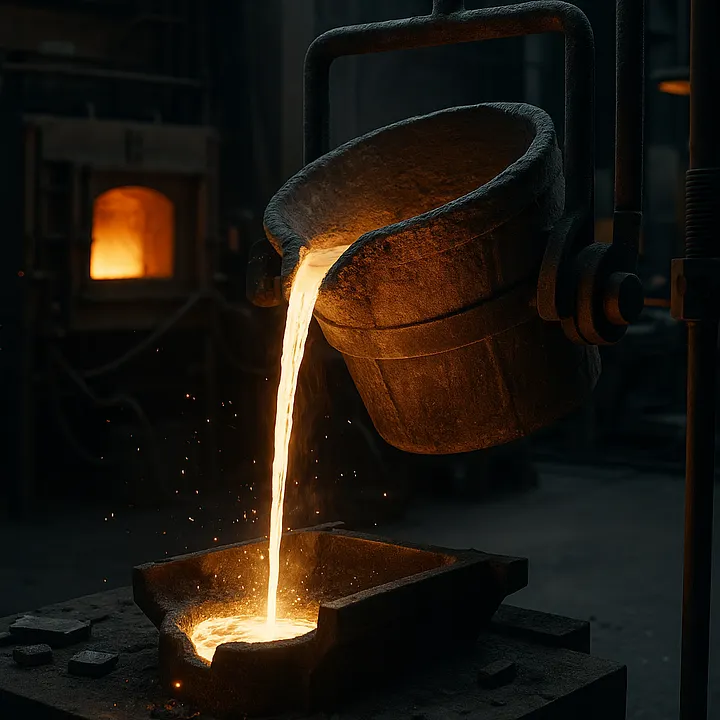
Massive Energy Consumption: To begin, a large industrial furnace must be fired up. This furnace will be charged with hundreds, sometimes thousands, of kilograms of solid metal ingots (aluminum or zinc alloy). The process of raising this massive thermal mass from ambient temperature to a molten state-over 660°C (1220°F) for aluminum-is an act of brute force energy consumption. This pre-heating process alone can take several hours and consumes a staggering amount of electricity or natural gas.
Continuous Energy for Thermal Stability: The furnace cannot be turned off and on. For the entire duration of the production run, which could be an 8-hour shift or multiple days, the furnace must continuously burn energy to maintain the molten metal at a very precise and stable temperature. A deviation of just a few degrees can drastically affect the casting quality.
Metallurgical Preparation: The molten metal isn’t just “melted.” It must be treated. This involves degassing the metal (typically with argon) to remove dissolved hydrogen that would cause porosity in the final parts, and adding grain refiners or other elements to ensure the final alloy meets its specified mechanical properties. This is a skilled, metallurgical process that adds to the setup time and cost.
This entire energy-intensive operation is a fixed cost. The furnace burns the same amount of energy to get ready, whether the final run is for one hour or one week.
Step 2: Installing the Fortress — The Art and Science of Die Setting
A die-casting tool is not a small, manageable object. It is a multi-ton fortress of hardened tool steel, and installing it into a die-casting machine is a complex and dangerous engineering task.
Die Pre-heating: A cold steel die cannot be hit with 660°C molten metal. The thermal shock would instantly cause catastrophic cracking and ruin the tool. Therefore, the entire multi-ton die must be pre-heated for several hours using specialized heating elements or torches until it reaches a stable operating temperature. This is another significant energy and time cost.
The Setting Process: A highly skilled die-setting technician uses an overhead crane to carefully hoist and install the massive, heated tool into the die-casting machine. This process is one of precision alignment, requiring the technician to secure the die, connect numerous hydraulic and cooling lines, and ensure the two halves of the die meet with microscopic accuracy. This process alone can take a full shift (4–8 hours) for a complex tool. The machine is non-productive during this entire time, yet its operational costs continue to accrue.
Step 3: The Trial by Fire — Process Stabilization and Inevitable Scrap
With the furnace hot and the die set, the machine is still not ready to produce good parts. It must go through a “warm-up” and stabilization phase.
“Seasoning” the System: The first several shots of molten metal are not intended to create good parts. They are used to bring the entire system-the die, the shot sleeve, the plunger-up to a stable, uniform operating temperature.
Parameter Optimization (“Dialing In”): The process engineer begins the meticulous task of tuning dozens of variables: the shot speed, the intensification pressure, the die temperature, the cooling time, the lubrication cycle, and more.
The Scrap Rate: During this critical stabilization period, the first 50 to 200+ shots are almost always scrap. These parts are visually inspected and taken to a quality control lab to be measured with a Coordinate Measuring Machine (CMM) and checked for porosity with X-rays. Based on this data, the engineer makes tiny adjustments, iterating over and over again until the process is stable and the parts are consistently meeting every dimensional and quality specification. All the metal, energy, lubricant, and machine time used to produce this initial scrap is a direct and unavoidable part of the setup cost.
The Unforgiving Math of Amortization: How MOQ Creates Profitability
Now that we understand the significant, recurring fixed costs, we can perform a simple calculation to see why the MOQ is not just a policy, but a mathematical necessity.
Let’s use a hypothetical but realistic scenario for an aluminum die-cast part:
- Total Fixed Setup Cost (Furnace Energy + Die Setting Labor + Pre-heating + Stabilization Scrap & Time): $4,000
- Per-Part Marginal Cost (The actual cost of the aluminum alloy, electricity, and lubricants for one good part): $1.50
- Price Quoted to Client per part: $3.50
- Gross Profit Per Part (to cover factory overhead, administration, and profit): $3.50 — $1.50 = $2.00
To simply cover the $4,000 setup cost, the factory must produce a certain number of parts. This is the crucial break-even point:
Break-Even Volume = Total Fixed Setup Cost / Gross Profit Per PartBreak-Even Volume = $4,000 / $2.00 per part = 2,000 parts
This calculation lays bare the entire logic. In this scenario, the MOQ would be set at or above 2,000 units. At this volume, the factory has finally paid for the cost of starting the job. Every unit produced beyond this point starts to generate the profit needed to sustain the business.
If the factory were to accept the client’s request for only 500 parts, the financial outcome would be a disaster: (500 parts * $2.00 profit/part) - $4,000 setup cost = $1,000 - $4,000 = -$3,000 (a substantial net loss)
Conclusion: MOQ is Not a Wall, It’s the Starting Line for Scale
The Minimum Order Quantity in die casting is not an arbitrary line in the sand. It is a carefully calculated threshold that represents the point where the immense power and efficiency of mass production are finally unlocked. It is the gate through which a project must pass to begin reaping the benefits of an incredibly low per-part cost, a benefit made possible only by amortizing the significant, unavoidable costs of setting up an industrial foundry process.
At IDMockup, we view this not as a limitation, but as part of our consultative role. We understand that not every project is immediately ready for a 3,000-piece run. This is precisely why we have built a comprehensive suite of services. For quantities that fall below the die-casting MOQ, our CNC Machining services are the perfect solution, allowing you to get real metal parts in low volumes without any tooling investment at all.
We see ourselves as partners in our clients’ growth. We are here to provide the perfect solution for the stage you are in today. We can machine your first ten prototypes, guide you through the tooling process, and then, when your market demand is ready, help you cross the MOQ threshold and scale your production to the tens of thousands.
Understanding the logic of the line is key to smart manufacturing. The MOQ is not a barrier to entry; it is the starting line for achieving true economies of scale. We invite you to partner with us, and we will help you build a manufacturing strategy that is perfectly aligned with your product’s lifecycle, every step of the way.