
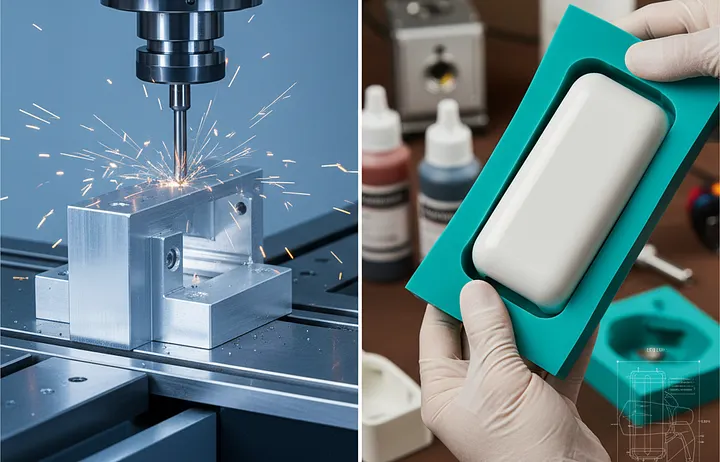
In the world of rapid prototyping and low-volume production, vacuum casting stands out as a uniquely powerful and versatile technology. For creating small batches (typically 10–50 units) of parts with a stunning, production-quality surface finish, it offers an almost magical combination of speed, material variety, and cost-effectiveness. It is the go-to process for innovators who need high-fidelity marketing samples, crucial pre-production units for clinical or field trials, or a set of aesthetically perfect parts for a final design review.
Yet, for engineers, designers, and procurement managers who are accustomed to the world of precision metalwork and rigid tooling, a common and important question often arises when reviewing the specifications for a vacuum-cast part. They see the beautiful finish and complex geometry, but then they see the dimensional tolerance-at IDMockup, we specify a typical tolerance of ±0.15mm for dimensions below 100mm, with an additional ±0.05mm for each subsequent 100mm-and they ask, “That’s an excellent tolerance for this process, but why is it not as razor-tight as CNC machining, which can hold ±0.01mm?”
This is a fantastic question. The answer is not a matter of quality or skill, but one of process physics and material science. At IDMockup & Precision Mold, we believe that an informed client is an empowered partner. Understanding the “why” behind the numbers is crucial for making the smartest manufacturing decisions for your project. The tolerance of vacuum casting is not a flaw; it is an inherent, predictable, and manageable characteristic of a process that offers incredible advantages in return.
This in-depth guide will walk you through the entire journey of a vacuum-cast part, from digital file to finished product. We will demystify the science behind its specifications and reveal how we harness and control these variables to deliver consistent, high-quality results every time.
The Foundational Difference: “Hard” Tooling vs. “Soft” Tooling
Before we can dissect the process itself, we must first understand the fundamental principle that separates vacuum casting from technologies like CNC machining or injection molding: the concept of “soft tooling.”
Hard Tooling & Direct Manufacturing
CNC machining is a direct manufacturing process that involves a rigid, unyielding cutting tool carving away material from a rigidly held, solid block of metal or plastic. Similarly, high-volume injection molding uses molds machined from massive, solid blocks of hardened steel. In these “hard tooling” scenarios, the system is defined by its rigidity. This rigidity is the very source of its extreme precision; there is virtually no flex, no give, and no deformation in the tooling.
Soft Tooling
Vacuum casting, by contrast, is the champion of “soft tooling.” The heart of the process is a mold created not from steel, but from a flexible, pliable, rubber-like silicone.
Think of it like the difference between baking a cake in a heavy, cast-iron pan versus baking it in a flexible silicone muffin cup. The cast-iron pan provides a rigid, unchanging boundary. The silicone cup, however, can be flexed, bent, and stretched. This flexibility is a tremendous feature. It is what allows us to easily de-mold parts with complex geometries and deep undercuts that would be impossible or prohibitively expensive to release from a hard mold. But this very same flexibility is also one of the primary sources of the process’s dimensional variability. This foundational concept of a pliant, “soft” mold is the key to understanding everything that follows.
The Journey of a Part: Deconstructing the Tolerance Stack-Up
The final tolerance of a vacuum-cast part is not the result of a single factor, but the cumulative result of several small, predictable dimensional changes that occur at each stage of the process. This is a classic engineering concept known as “tolerance stack-up.” Let’s follow the journey of a part to see where these variations are introduced.
Step 1: The Genesis — The Master Pattern’s Inherent Tolerance
Every vacuum casting project begins with the creation of a master pattern. This is a perfect, 1:1 physical replica of the final part, and it serves as the “master” from which the silicone mold will be made. The quality of every subsequent copy is fundamentally limited by the quality of this initial master pattern.
At IDMockup, we typically create these masters using one of our most precise technologies: industrial-grade SLA 3D printing or high-precision CNC machining. While these processes are incredibly accurate, they too have their own tight, but non-zero, manufacturing tolerances. For example, a CNC-machined master will be accurate to within a few hundredths of a millimeter. This initial, minuscule deviation from the perfect digital CAD model is the very first link in our tolerance chain. It is the genetic code that will be passed down through the rest of the process.
Step 2: The First Transformation — The Shrinkage of the Silicone Mold
Once the perfect master pattern is created and meticulously hand-finished, it is placed in a casting box, and liquid silicone is poured around it. Over several hours, this liquid silicone undergoes a chemical reaction called polymerization, curing into the solid, flexible mold.
Here, we encounter the first crucial law of material science in this process: volumetric shrinkage. As the long chains of silicone polymer molecules arrange themselves from a disordered liquid into a more structured solid, the overall volume of the material decreases slightly but measurably. This shrinkage rate is a known property of the specific type of silicone we use, typically in the range of 0.1% to 0.2%.
The consequence of this is significant: the internal cavity of the cured silicone mold is now already slightly smaller than the master pattern it was formed around. This is the first major, predictable factor that contributes to the overall tolerance stack-up.
Step 3: The Second Transformation — The Shrinkage of the Casting Resin
With the silicone mold prepared, we are ready for the casting itself. A liquid polyurethane (PU) casting resin, chosen to mimic the properties of the client’s desired production plastic (e.g., ABS, PC, rubber), is mixed and poured into the mold cavity under a vacuum to eliminate any air bubbles. Now, the second critical transformation occurs.
Just like the silicone, this liquid PU resin undergoes its own chemical reaction to cure into the final solid plastic part. And, just like the silicone, it also experiences volumetric shrinkage as it solidifies.
Crucially, the shrinkage rate of PU resins varies significantly depending on the formulation. A rigid, glass-filled polyurethane designed to mimic nylon might shrink by 0.15%. A soft, flexible, 40 Shore A polyurethane meant to simulate a rubber gasket could shrink by 0.5% or even more. This “double shrinkage” effect-the resin shrinking within a mold that has already shrunk-is the largest and most significant contributor to the final dimensional offset of the part. The final cast part will be slightly smaller than the mold cavity it was cast in.
Step 4: The Craftsmanship Factor — Managing Environmental and Physical Variables
Beyond the predictable physics of material shrinkage, the “soft tooling” nature of the process introduces variables that are managed through the skill and experience of our technicians.
The “Soft” Mold Factor: The very flexibility that makes the silicone mold so useful also means it’s not perfectly rigid. The manual process of de-molding each part-carefully flexing the mold to release the finished component-can cause microscopic stretching or distortion. Over the course of its 15–25 shot lifespan, these tiny changes can introduce slight variations from the first copy to the last.
Environmental Controls: Factors such as the ambient temperature and humidity in our casting lab can have a subtle effect on the chemical reaction speed and, therefore, the precise final shrinkage rates of both the silicone and the polyurethane resins.
This is where the craft of vacuum casting comes into sharp focus. Our highly experienced technicians at IDMockup manage these variables through meticulous process control, consistent handling techniques, and a climate-controlled environment. While we minimize these effects, they are an inseparable part of any manufacturing process that relies on the skill of a craftsman interacting with “soft” tooling.
The Art of Compensation: How We Engineer for Precision
So, if we have a master pattern with its own tolerance, a mold that shrinks, and a resin that shrinks within that mold, how do we possibly achieve a consistent and reliable final tolerance of ±0.15mm?
The answer lies in the art and science of compensation.
Our engineers are not just manufacturing technicians; they are material science consultants. When a client project begins, our process is not to simply take the 1:1 CAD file and create the master pattern. Instead, we perform a series of calculations. Based on the specific PU casting resin selected for the project and its documented shrinkage rate, we will strategically and precisely upscale the original CAD model before we even begin to create the master pattern.
For a resin with a total calculated process shrinkage of 0.35%, we will create a master pattern that is intentionally 100.35% of the desired final size. This expertly oversized master, when subjected to the double shrinkage of the process, results in a final part that lands squarely within the desired dimensional tolerance. This crucial, knowledge-based step is what separates professional, industrial-grade vacuum casting from a hobbyist endeavor. It is a testament to a deep understanding of the entire process chain.
Conclusion: An Informed Choice for a Smarter Development Cycle
The dimensional tolerance of vacuum casting is, therefore, not a mystery or a flaw. It is the logical and predictable sum of its parts: the inherent nature of a flexible, soft mold, and the unavoidable physics of double material shrinkage.
The value proposition becomes crystal clear. In exchange for a dimensional tolerance measured in tenths of a millimeter rather than hundredths, a client receives:
- Incredible Speed: From a finalized design to a small batch of 15 finished parts in as little as 7–10 days.
- Drastically Lower Initial Cost: The cost of a silicone mold is a tiny fraction of the cost of a steel injection mold, eliminating huge financial risks in the early stages.
- Stunning Aesthetic Quality: The surface finish can be virtually indistinguishable from a final production part.
- Material Versatility: The ability to simulate a vast range of materials and durometers.
For applications requiring the absolute pinnacle of micron-level accuracy, our CNC machining services are, and always will be, the definitive answer. But for the crucial phase of product development that demands small batches of high-quality, aesthetically superb parts for market testing, user trials, and final design validation, vacuum casting offers an unbeatable strategic advantage.
Understanding the “why” behind the numbers empowers you to make the best manufacturing choices for your project at every stage. We invite you to bring us your next challenge, and our engineering team will be delighted to consult with you on which of our expert processes is the perfect fit to bring your vision to life.