
In the world of product manufacturing, a common and perfectly logical question often arises at a critical juncture. A client, having invested a significant sum in high-quality tooling-be it an injection mold, a die-casting tool, or an extrusion die-receives their first quote for a production run. Scrutinizing the details, they see a line item that seems redundant: “Secondary CNC Machining Operations.”
The immediate thought is understandable: “Why do I need to pay for CNC machining? Didn’t I just invest thousands of dollars in a tool that is supposed to create the finished part?”
This is an excellent question, and the answer gets to the very heart of what separates standard manufacturing from truly high-quality, precision manufacturing. The common perception of processes like injection molding or die casting is that of a single, magical step-raw material goes in, and a perfect, completed part comes out. The reality, however, is far more nuanced and sophisticated.
At IDMockup & Precision Mold, our expertise spans the entire manufacturing spectrum, from initial CNC prototypes to high-volume production using advanced tooling. This integrated knowledge allows us to design holistic production strategies where powerful mass-production processes work in powerful synergy with the uncompromising precision of CNC machining. The truth is that CNC is not a competitor or a redundant alternative to these methods; it is their most crucial, often invisible, partner.
This article will pull back the curtain on the modern manufacturing workflow to reveal the two fundamental roles that CNC machining plays: first, as the hidden architect that makes your mass production possible, and second, as the master finisher that elevates your parts from “nearly perfect” to “flawless.”
Role 1: The Hidden Architect — CNC Machining as the Creator of Your Molds and Tooling
Before you can replicate a million components with breathtaking speed and efficiency, you must first create one perfect master: the tool itself. Whether it’s a hardened steel mold for injection molding, a robust tool for die casting, or a precision die for aluminum extrusion, this tooling is the heart of the entire production run. The quality, precision, and lifespan of every single part you produce are born from the quality and precision of this tool.
And how is this incredibly precise, complex tooling made? It is born from CNC machining.
The “garbage in, garbage out” principle has never been more applicable. Any microscopic flaw, any deviation from the CAD model in the mold’s cavity, will be faithfully and relentlessly replicated on every single part that tool ever produces. This is why the creation of the mold is the most critical, most precision-obsessed stage of the entire process, and it relies almost exclusively on the capabilities of CNC machining and its related technologies, like Electrical Discharge Machining (EDM).
Let’s break down how we build the foundation for your production:
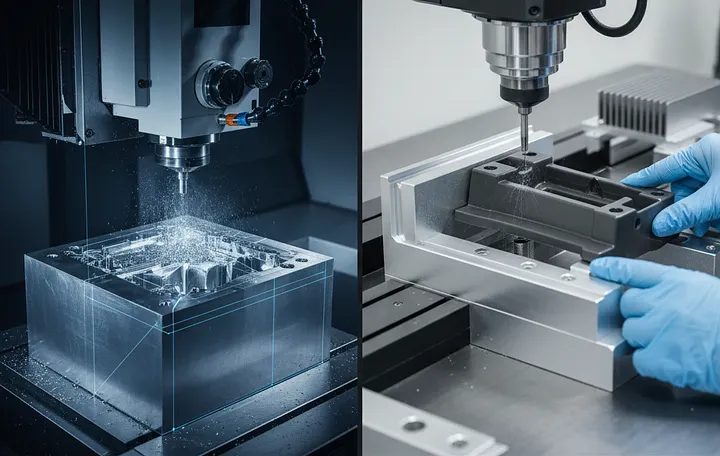
- Milling the Cavity and Core: A mold is typically made from massive blocks of hardened steel (like P20 or H13) or high-grade aluminum. Our advanced 3-axis and 5-axis CNC milling centers go to work, meticulously carving away material, layer by layer, to create the negative space of your part. The contours, the textures, the critical shut-off surfaces-all are machined to micron-level accuracy. This process can take hundreds of hours of continuous machine time, guided by sophisticated CAM programming to ensure every surface is perfect.
- Creating Features Beyond the Mill: Some features, like sharp internal corners or deep, narrow ribs, are physically impossible for a rotating cutting tool to create. This is where CNC-driven EDM comes into play. We first CNC machine a graphite electrode in the precise shape of the feature we want to create. This electrode is then used to erode the hardened steel of the mold with high-voltage sparks, creating the feature with perfect sharpness and accuracy.
- Building the Machine Within the Machine: A modern mold is not just a block of steel; it’s a complex machine in its own right. It contains cooling channels to control temperature, slides and lifters to form undercuts, and an ejector system to release the part. Every single one of these intricate components is created using CNC milling, turning, and grinding to ensure they work together flawlessly for millions of cycles.
So, when you invest in “Rapid Tooling” or “Production Tooling” from IDMockup, you are, in fact, commissioning a masterpiece of CNC machining. You are leveraging our core competency in precision manufacturing to build the very foundation of your product’s quality. The first answer to “Why do I still need CNC?” is that you’ve already been benefiting from it from the very beginning.
Role 2: The Master Finisher — CNC as the Secondary Process for Perfecting Parts
Once the high-quality, CNC-machined tool is complete, the mass production process can begin. Processes like injection molding, die casting, and aluminum extrusion are miracles of efficiency, capable of producing the basic shape of your part in a matter of seconds. The parts that emerge are known in the industry as “near-net-shape.”
“Near-net-shape” is the key phrase. The part is almost perfect. It has the correct general form and features. But due to the inherent physics of these processes-the shrinkage of cooling plastic, the need for draft angles, the realities of molten metal flow-they often cannot achieve the absolute final precision required for every single feature.
This is where secondary CNC machining comes in as a planned, strategic step to take a part from 99% complete to 100% perfect. Let’s look at specific examples.
A. For Injection Molded & Die-Cast Parts
- Achieving Critical Tolerances: Imagine your plastic housing needs to accept a high-precision ball bearing. The drawing calls for the hole to have a tolerance of ±0.02mm for a perfect press-fit. Due to the natural shrinkage and slight warpage of plastic as it cools in the mold, achieving this tolerance directly from the mold on every single shot is nearly impossible. The smart manufacturing solution? We design the mold to create a hole that is intentionally slightly undersized. Then, as a secondary step, each part is put into a CNC fixture, and a boring tool machines the hole to its exact, final dimension, every single time. This hybrid approach leverages the speed of molding and the precision of CNC to achieve a result that is both fast and flawless.
- Adding Precision Features (Threads, Undercuts): Your design requires a fine-pitched metal thread insert or a complex side-hole (an undercut). Creating these features within the mold would require incredibly complex and expensive mechanisms like collapsing cores or side-action cams, dramatically increasing the cost and potential failure points of the tool. A far more elegant and cost-effective strategy is to design a simpler, more robust mold and then use a secondary CNC operation to drill and tap the threads or machine the side-hole. This is a perfect example of Design for Manufacturability (DFM), where we use a combination of processes to achieve the best result at the lowest overall cost.
- Perfecting Mating Surfaces: For products like waterproof electronics enclosures, the two halves must seal perfectly. Even a minuscule amount of warpage from the molding process could compromise the seal. A common solution is to include a “kiss” of CNC milling on the sealing surfaces after molding. This creates an optically flat, perfect mating surface to ensure a reliable O-ring seal.
- Cosmetic Perfection: High-end products demand a flawless finish. Secondary CNC machining can be used to remove any trace of a parting line or a gate vestige, or to machine a crisp, diamond-cut chamfer on the edge of a part for a premium aesthetic touch.
B. For Aluminum Extruded Parts
Aluminum extrusion is a brilliantly efficient process for creating complex linear profiles. It’s how we get everything from window frames to intricate server heatsinks. But the extrusion process itself only creates a long, continuous profile. It is just a raw material until CNC machining transforms it into a functional component.
The Transformative Role of CNC: Consider an extruded aluminum heatsink for a piece of networking equipment. The extrusion process efficiently creates the complex fin geometry along its entire length. But to become a usable part, it must be brought to our CNC department.
- Cut to Length: A CNC saw or mill cuts the profile to the precise required length.
- Add Mounting Features: A CNC mill drills and taps a precise pattern of holes for mounting the heatsink to the PCB and for attaching fans.
- Add Specific Features: The CNC machine might mill away a section of fins to provide clearance for a tall capacitor, or machine pockets and other features specific to that product’s design.
The partnership is perfect: extrusion creates the complex 2D profile with great efficiency, and CNC adds all the 3D features that make it a unique, functional, and product-specific component.
Conclusion: A Symphony of Processes, Conducted by Experts
So, when you see “Secondary CNC Machining” on a production quote, it should not be a cause for concern. On the contrary, it should be a source of confidence. It is a hallmark of a thorough, high-quality manufacturing plan. It demonstrates that your manufacturing partner understands the inherent limitations of every process and is proactively using the right tool for each specific feature to ensure the final result meets your most demanding specifications.
CNC machining is not a competing process to molding, casting, or extrusion. It is their most vital partner. It is the hidden architect that builds the tools to make them possible, and it is the master craftsman that provides the final, perfect touch.
At IDMockup, our mastery of this entire process symphony is our greatest strength. We design molds knowing which features are best left for post-machining. We plan extrusion runs in conjunction with the necessary secondary CNC operations. This holistic, integrated approach ensures the highest quality outcome in the most efficient and cost-effective manner. When you partner with us, you are not just hiring a supplier; you are collaborating with a team of manufacturing strategists. Let’s work together to conduct a masterpiece of production.