
In the dynamic arena of modern product development, vacuum casting has rightfully earned its reputation as a hero technology. For innovators needing to bridge the gap between a single prototype and full-scale production, it is a game-changer. The ability to create a small batch-typically 10 to 50 units-of visually stunning, cosmetically flawless parts in a matter of days is nothing short of revolutionary. It empowers companies to conduct meaningful user trials, generate high-quality marketing assets, and secure stakeholder buy-in with a speed and cost-effectiveness that was once unimaginable.
We at IDMockup & Precision Mold have been privileged to witness the power of this process firsthand, helping countless clients bring their ideas to life with breathtaking fidelity. The success of these initial runs often leads to a natural and exciting question: “This process was fantastic for our first 20 units. Can we just use this for our initial market launch of 200, 300, or even 500 units?”
While the enthusiasm is both welcome and understandable, this is the point where a responsible, experienced manufacturing partner steps in to have a deeper, more strategic conversation. The truth is, while vacuum casting is an unparalleled tool within its specific operational window, it is not a one-size-fits-all solution for every small-batch plastic production need.
Understanding the boundaries of a technology is just as important as understanding its strengths. The mark of a true manufacturing partner is not the ability to say “yes” to every request, but the expertise and integrity to know when to advise, “There is a better, more effective way.” This in-depth guide will explore the four critical boundaries of vacuum casting-Material Authenticity, Production Quantity, Dimensional Precision, and Geometric Extremes-to provide a clear framework on why it is a specialized solution, and to help you make the most informed choices for your low-volume production needs.
Boundary #1: The Material Mirage — The Unyielding Demand for True Engineering Plastics
This is the most fundamental and critical boundary of the vacuum casting process. The technology uses liquid polyurethane (PU) resins, which are chemically engineered to be brilliant simulants of common production plastics. Our library of PU resins can expertly mimic the color, texture, and general feel of materials like ABS, PC, Nylon, and various rubbers. For an appearance model or a form-and-fit prototype, this simulation is often more than sufficient.
However, for a functional part that will be subjected to real-world performance demands, “simulation” is not enough.
Mechanical and Thermal Performance: A PU resin that “feels like ABS” does not possess the same certified technical datasheet properties as a true, injection-molded ABS pellet. It will not have the same tensile strength, long-term fatigue life, or impact resistance as defined by industry standards like Izod or Charpy. More critically, PU resins have a significantly lower heat deflection temperature (HDT). A vacuum-cast enclosure for a heat-generating electronic device might look perfect, but it could warp and fail once the device is powered on. For applications that require the true, documented thermal performance of production-grade PEEK, Ultem, or even standard Polycarbonate, a PU simulant is not a viable option.
Chemical Resistance: Product housings are often exposed to cleaning agents, oils, or other chemicals. The chemical resistance of a specific PU resin may be completely different from that of the intended production material, such as Polypropylene (PP) or Acetal (POM). A prototype that holds up to a chemical wipe-down in the lab could fail in the field, leading to misleading test results.
Regulatory Compliance: This is a non-negotiable barrier, particularly in the medical and food-service industries. Production parts often must be made from materials that carry specific certifications, such as FDA approval for food contact or USP Class VI for biocompatibility. PU casting resins are generally not certified to these standards. Using a simulant for any testing that will be submitted for regulatory approval is impossible.
The Alternative Path
When your low-volume production run is for parts that must perform-mechanically, thermally, chemically, or regulatorily-the demand for material authenticity is absolute. In this scenario, the conversation shifts from casting to CNC Machining. By machining the parts directly from a solid block of the exact production-grade plastic, from certified PEEK to UL94-V0 rated PC/ABS, you are creating true, production-equivalent components. The data from testing these parts is not simulated; it is real and reliable. Our role at IDMockup is to identify this need early, guiding you away from vacuum casting for functional parts and toward the certainty of CNC.
Boundary #2: The Finite Frontier — The Unavoidable Lifespan of the Soft Mold
The economic brilliance of vacuum casting lies in its low-cost “soft” tooling-the flexible silicone mold. But this advantage is directly tied to its primary limitation in terms of quantity. A silicone mold is a consumable item with a finite, and relatively short, lifespan.
The Science of Mold Degradation: The process of casting involves a chemical reaction. The liquid PU resin, as it cures, has a slight chemical interaction with the surface of the silicone mold. With each successive part, or “shot,” this interaction minutely breaks down the mold’s finest surface details. Furthermore, the physical stress of de-molding each part-flexing and stretching the mold to release the component-causes microscopic wear and tear.
The Production Ceiling: Through extensive experience, the industry standard is clear: a single, high-quality silicone mold can be relied upon to produce approximately 15 to 25 high-fidelity copies. Beyond this point, the quality begins to degrade. Fine textures become muted, sharp edges soften, and the risk of dimensional deviation increases.
The Economic Tipping Point: This creates a very clear ceiling on production quantity. If your need is for 20 parts, creating one master pattern and one silicone mold is incredibly efficient. But what if you need 200 parts? This would require us to create at least 8 to 10 separate silicone molds, and potentially even new master patterns along the way to ensure fidelity. The repetitive labor and material costs associated with creating so many molds quickly accumulate. At a certain point, the total project cost surpasses that of a more durable tooling solution.
The Alternative Path
When your required quantity moves beyond the 50-unit threshold and into the low hundreds or thousands, you have crossed the economic boundary of vacuum casting. This is where the manufacturing conversation at IDMockup transitions to Rapid Tooling. By investing in a more durable, CNC-machined mold made from aluminum or soft steel (P20), we can leverage the true injection molding process. While the initial tooling investment is higher than for a single silicone mold, the cost-per-part is drastically lower, and the tool can produce thousands of identical parts. We help our clients identify this crucial economic tipping point, ensuring they are always using the most cost-effective process for their required volume.
Boundary #3: The Precision Imperative — When Tolerances are Non-Negotiable
As we explored in our previous deep dive, the tolerance of vacuum casting (typically ±0.15mm per 100mm) is a result of the process’s inherent physics-the “soft” mold and the “double shrinkage” of both the silicone and the resin. For aesthetic models and general assemblies, this level of precision is excellent. However, in the world of high-performance engineering, it presents a clear boundary.
Applications Requiring Higher Precision
Consider the following scenarios:
- A gearbox housing where two shafts must be held in a parallel position with extreme accuracy.
- A medical device with a precision press-fit for a metal bearing or pin.
- A component with a finely machined groove for an O-ring, where the exact compression ratio is critical for a waterproof seal.
- An optical device where the alignment of lenses and sensors is measured in microns.
In these applications, a potential deviation of 0.15mm is not acceptable; it is the difference between a functional product and a piece of scrap.
The Alternative Path
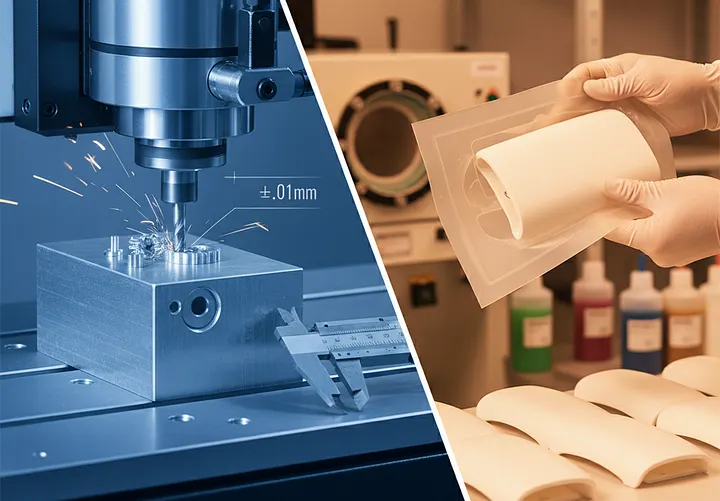
When your design’s success is dictated by tight, non-negotiable tolerances, you have crossed the precision boundary of vacuum casting. The definitive solution is CNC Machining. As a direct manufacturing process with rigid tooling and computer control, CNC can reliably hold tolerances of ±0.01mm to ±0.05mm, an order of magnitude more precise than vacuum casting. Our consultative process at IDMockup involves a thorough review of your design’s drawings and tolerance callouts. If we identify a critical-to-function dimension that vacuum casting cannot reliably achieve, we will proactively recommend that the entire part, or at least that critical feature, be machined to guarantee performance and eliminate risk.
Boundary #4: The Extremes of Geometry — Too Big, Too Small, or Too Delicate
While vacuum casting is remarkably versatile, the physical process does have its geometric limitations.
The “Too Big” Problem: Extremely large parts, such as a full automotive dashboard or bumper, present significant challenges. They require a massive volume of silicone and resin, making the process costly. Controlling the flow and curing of the resin consistently over such a large area to prevent warpage can be very difficult. Furthermore, the physical size of the vacuum chamber itself sets a hard limit on the part dimensions.
The “Too Delicate” Problem: Conversely, parts with extremely fine, fragile, or delicate features can also be problematic. Long, slender pins or walls thinner than 0.75mm can be difficult to cast reliably. More importantly, these delicate features can easily break during the repeated stress of being de-molded from the somewhat tacky surface of the silicone mold.
The Alternative Path
For parts that are too large, the best solution is often CNC Machining or reaction injection molding (RIM) in several sections, which are then expertly bonded and finished to create a seamless final part. For parts with features that are too delicate and fine, high-resolution SLA 3D Printing or direct CNC Machining offer a much higher degree of success and repeatability, as they do not involve a stressful manual de-molding process. Our team’s deep experience allows us to identify these geometric risks during the initial design review, saving clients the time and expense of a failed casting and guiding them toward a more robust manufacturing method.
Conclusion: Choosing the Right Path to Production
Vacuum casting is, and will remain, one of the most powerful and valuable tools in the product development arsenal. Its “sweet spot”-for producing 10 to 50 units of aesthetically driven parts for non-critical functional testing-is undeniable.
However, understanding its boundaries is key to using it wisely. When your project’s primary demands are certified material performance, quantities in the hundreds, micron-level precision, or extreme geometries, you have moved beyond the sweet spot. Acknowledging this is not a weakness; it is a sign of a mature and strategic approach to manufacturing.
The mark of a true manufacturing partner is not the ability to say “yes” to every request, but the expertise and integrity to know when to say, “There is a better way.” At IDMockup, we have mastered the entire spectrum of prototyping and low-volume production technologies. Our unwavering commitment is to your project’s ultimate success. We invite you to bring us your next challenge, and allow our team of experts to guide you to the perfect manufacturing solution, whether it’s the artistry of vacuum casting, the precision of CNC, or the scalability of rapid tooling.