
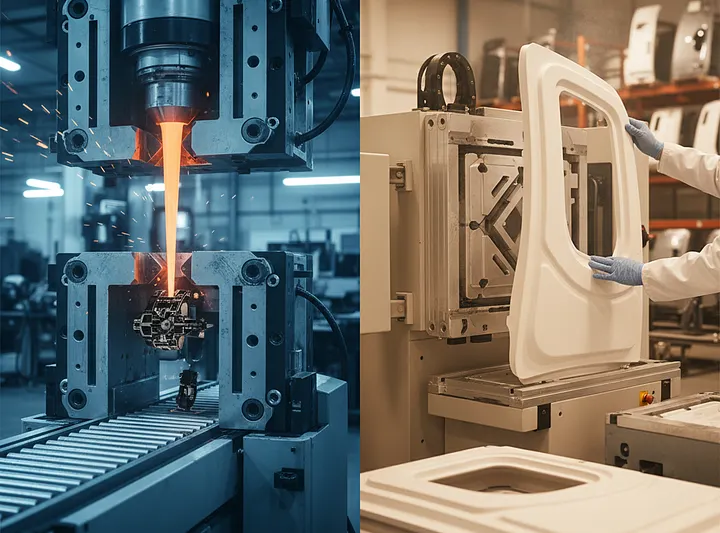
In the vast and varied world of plastic manufacturing, high-pressure injection molding stands as the undisputed king. It is the powerhouse process behind billions of complex, precise, and affordable plastic parts that shape our daily lives, from intricate electronic connectors to the ubiquitous caps on our water bottles. At IDMockup, we have mastered this technology, delivering millions of high-quality components to our clients with the speed and precision the modern market demands.
But what happens when the scale of the challenge changes dramatically? What about the really big stuff? Consider the sweeping, aerodynamic front bumper of a specialty vehicle, the expansive, multi-part housing for an advanced MRI machine, or the durable, lightweight panels for an agricultural drone. For these large-scale applications, trying to use traditional high-pressure injection molding can become an engineering and economic challenge of colossal proportions.
This is where a different, highly specialized technology often steps into the spotlight: Reaction Injection Molding (RIM), also known in the industry as low-pressure injection molding. This powerful process is the go-to solution for creating large, lightweight, and incredibly durable plastic parts. This specialization often leads to a perceptive question from our clients: “If RIM is so effective for these large, high-value components, why don’t we see it used for smaller, everyday parts?”
The answer lies in a fascinating interplay of chemistry, physics, and economics. RIM’s dominance in the world of large parts is not an arbitrary limitation but a direct consequence of its unique chemical process, its distinct tooling philosophy, and its specific cycle time efficiencies. This in-depth guide will explore the four key pillars that make RIM the undisputed champion of large-part production and, in doing so, reveal why it is fundamentally unsuited for the small-part world.
A Tale of Two Processes: High-Pressure Thermoplastics vs. Low-Pressure Thermosets
To understand RIM’s specialization, one must first grasp how fundamentally different it is from the conventional injection molding process that most people are familiar with. They are two entirely different paths to a molded part.
Conventional High-Pressure Injection Molding (The Powerhouse)
This is a process of immense physical force and thermal change. It begins with solid thermoplastic pellets (like ABS, PC, or PP), which are heated in a barrel until they become a thick, molten, viscous liquid. This molten plastic is then injected into a mold under immense pressure-often ranging from 10,000 to 30,000 PSI. The machines required are gigantic, with clamping forces of hundreds or thousands of tons needed to hold the two halves of the hardened steel mold together against this incredible injection force. The cycle is a marvel of speed, often taking just 15 to 60 seconds to inject, cool, and eject a finished part. Think of it as a high-powered, brutally efficient, and extremely precise squirt gun.
Reaction Injection Molding (RIM) (The Gentle Giant)
RIM, on the other hand, is a process of chemical creation rather than physical force. It begins not with solid pellets, but with two distinct low-viscosity liquid components (typically a polyol and an isocyanate). These liquids are precisely metered and mixed at a relatively low pressure inside a mixhead. This reactive mixture is then gently injected into a closed mold at a very low pressure, often less than 100 PSI. Inside the mold, a rapid exothermic (heat-generating) chemical reaction occurs. The liquids cross-link and expand to create a thermoset polyurethane part, curing from the inside out. The cycle is a more patient affair, typically taking between three to eight minutes to allow the chemical reaction to complete. Think of it less like a squirt gun and more like a two-part epoxy being precisely mixed and poured into a mold to create a new, solid material.
This fundamental difference-a physical state change under brutal force versus a chemical creation process under gentle pressure-is the key that unlocks the answer to why each process dominates its respective scale.
The Four Pillars of RIM’s Large-Part Specialization
Let’s dissect the four core factors that make RIM the perfect solution for large components.
Pillar I: The Physics of Flow — The Gentle River vs. The High-Pressure Jet
The first and most significant challenge in molding a large part is simply getting the material to fill the entire mold cavity before it cools and solidifies.
The High-Pressure Challenge: Forcing a thick, viscous molten thermoplastic across the vast, often complex geography of a large mold (like a car door panel) is an immense challenge. It requires extraordinarily high pressures to push the material to the farthest corners. This, in turn, requires colossal and incredibly expensive injection molding machines with massive clamping forces to prevent the mold from being blown apart by the internal pressure. The sheer scale and cost of the required machinery for very large parts can be prohibitive.
RIM’s Elegant Solution: RIM’s two starting components are low-viscosity liquids, often with a consistency similar to motor oil. These liquids flow easily, like a gentle river, under very low pressure. They can travel long distances within a mold cavity, filling every intricate detail and feature without requiring thousands of tons of force. This “gentle fill” means the machines and clamping units required for RIM are significantly smaller, less powerful, and therefore less expensive for a given part size.
Why It Fails for Small Parts: This gentle, slower flow is a disadvantage at a small scale. For a tiny, intricate part like an electronic connector, the high-pressure, high-speed “jet” of traditional injection molding is far superior at rapidly and precisely filling all the micro-features, pins, and snaps. The RIM process is simply too slow and lacks the forceful injection needed to perfectly replicate features at a miniature scale.
Pillar II: The Economics of Tooling — The “Big Mold” Advantage
The single largest investment in any molding project is the tool itself. The economics of this tooling are perhaps the clearest reason for RIM’s specialization.
The Prohibitive Cost of Large Steel Molds: The immense pressures of high-pressure injection molding mandate that the molds be made from incredibly strong, durable, and expensive materials like hardened P20 or H13 tool steel. The cost of machining a massive block of this steel into a complex mold for a part the size of a car bumper can easily run into hundreds of thousands of dollars, an investment that is simply not feasible for products with low-to-medium volume demand.
RIM’s Aluminum Advantage: Because the internal pressures in the RIM process are so low, the mold does not need to be a fortress of hardened steel. RIM molds are typically machined from high-grade aluminum. Aluminum is significantly cheaper than tool steel, and it is much softer, meaning it can be machined in a fraction of the time. This results in a tooling cost that is dramatically lower-often 50–70% less-than an equivalent steel injection mold.
The Critical Scaling Effect: This cost saving between aluminum and steel becomes exponentially more significant as the size of the mold increases. For a very small part the size of a keychain, the cost difference between a small aluminum mold and a small steel mold is not dramatic. The aluminum RIM mold, while cheaper, is still far more expensive than other low-volume methods like vacuum casting. However, when you scale up to a mold the size of a tractor roof, the cost difference is no longer incremental; it’s a chasm. The savings can be the difference between a project being profitable and being completely unviable. RIM’s tooling cost advantage is only truly realized at a very large scale, making it the perfect fit for low-to-medium volume large parts.
Pillar III: The Efficiency of Time — The “Value per Minute” Equation
A simple comparison of cycle times would suggest that RIM is hopelessly inefficient. But efficiency must be measured in terms of the value generated per unit of time.
The Cycle Time Difference: As mentioned, a typical injection molding cycle is measured in seconds (e.g., 30 seconds). A typical RIM cycle is measured in minutes (e.g., 5 minutes). This is because the RIM part needs time for the chemical reaction to fully complete and cure within the mold.
Why RIM is Inefficient for Small Parts: If you are making small, 5-gram plastic caps, this difference is a death sentence for RIM. A traditional injection molding machine with a 32-cavity mold could produce over 2,000 caps in the time it takes a RIM machine to produce just one. The throughput is orders of magnitude lower.
Why RIM is Highly Efficient for Large Parts: Now, let’s reframe the calculation. Imagine you are producing a single, 10-kilogram panel for a medical imaging device. A 5-minute cycle time to produce such a large, complex, and high-value part is actually considered very efficient. The “kilograms of material processed per hour” is very high. The significant value and structural complexity of that single part more than justifies the longer cycle time. The efficiency of RIM is therefore not measured in “parts per hour,” but in the “volume and value of the part produced per cycle.”
Pillar IV: The Nature of the Material — Inherent Properties for Structural Parts
Finally, the material that the RIM process creates is uniquely suited for the demands of large components.
The Advantage of Thermoset Polyurethane: The resulting thermoset polyurethane is a marvel of engineering. It is incredibly tough, durable, and resistant to impact and temperature changes. Crucially, the RIM process can be controlled to create parts with a high-density, solid outer “skin” and a lower-density, microcellular inner “core.” This composite-like structure creates a part with an exceptionally high stiffness-to-weight ratio.
Ideal for Large Structures: These properties are perfect for large, self-supporting structural components like equipment housings, body panels, and enclosures. The material is inherently strong and lightweight, exactly what is needed for these applications.
Design Freedom: The low-pressure filling process is also extremely forgiving of designs that feature significant variations in wall thickness. Trying to mold a part that is 3mm thick in one area and 12mm thick in another with high-pressure injection molding is a recipe for defects like sink marks and voids. RIM handles these variations with ease, giving designers far greater freedom when creating large, complex structures.
Conclusion: A Specialized Tool Engineered for a Grand Scale
Reaction Injection Molding’s specialization in large parts is not a limitation but a testament to its highly engineered focus. It is a process born from a different philosophy than its high-pressure cousin. Its gentle flow physics, its aluminum-based tooling economics, its value-per-minute cycle efficiency, and its creation of strong, lightweight thermoset materials all converge to make it the definitive and unparalleled solution when a project demands large, complex, and durable plastic parts in low-to-medium volumes.
At IDMockup, our mastery of the full spectrum of molding technologies allows us to provide our clients with honest, data-driven guidance. While we rely on the speed and power of high-pressure injection molding for your high-volume small parts, we also deeply understand and respect the powerful and strategic niche of RIM. We don’t force a project into a process; we match the process to the project’s unique scale and ambition. Whether your component is the size of a coin or the size of a car door, we have the expertise to bring it to life in the most intelligent, efficient, and effective way possible.