
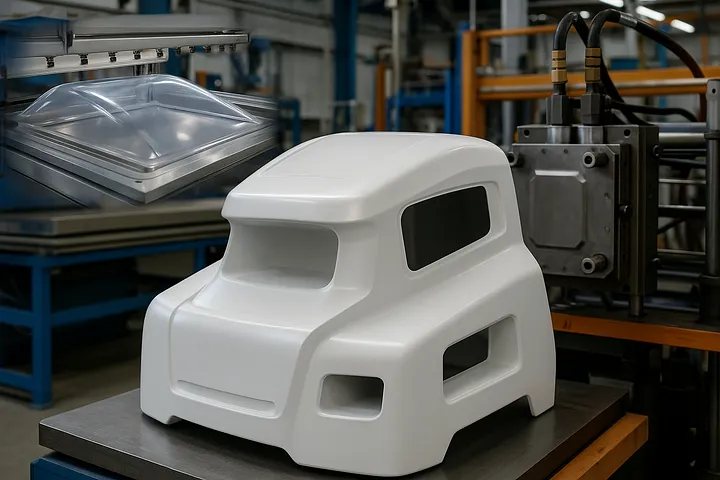
Your team has done it. After months of intensive design and engineering, the CAD model for the large, elegant plastic housing of your new industrial robot is finalized. It’s a moment of achievement, but it’s immediately followed by a critical, and often complex, manufacturing decision. You need to bring this digital concept to life, but you’re in the challenging space of low-to-medium volume production-perhaps a few hundred units for the first market launch.
In this scenario, the colossal cost and long lead times of traditional high-pressure injection molding, a process we at IDMockup have mastered for high-volume production, are often prohibitive. This reality brings two powerful and specialized alternatives to the forefront: Thermoforming and Reaction Injection Molding (RIM).
On the surface, they may seem similar; both are excellent for producing large plastic parts without the astronomical tooling costs of their high-volume cousin. However, in reality, they are fundamentally different technologies, born from different principles and engineered to solve different problems. They each have a distinct profile of strengths, weaknesses, costs, and capabilities.
This often leads to the crucial question our clients ask us every day: “Which method is the superior choice for my project?”
As manufacturing experts who navigate these choices with clients daily, we at IDMockup believe in providing clarity and empowering informed decisions. The answer isn’t about which process is universally “better,” but which is the perfect fit for your product’s specific requirements. Choosing the wrong path can lead to compromised performance, unexpected costs, and a product that fails to meet its potential.
This in-depth guide will serve as your strategic compass. We will dissect these two powerful technologies, compare them across four critical decision-making factors, and provide a clear framework to help you choose the ideal process for your next large-part project.
Process Snapshot: The Art of Reshaping vs. The Science of Creating
Before we can compare them, we must first understand their fundamentally different approaches to creating a part.
Thermoforming: The Art of Reshaping
At its core, thermoforming is an elegant process of transformation. It begins with a flat, solid sheet of thermoplastic material (like ABS, HIPS, or PC). This sheet is heated in an oven until it becomes soft and pliable. The softened sheet is then draped over a single-sided mold, and a vacuum is applied, pulling the sheet down to conform perfectly to the mold’s shape. After cooling, the newly formed part is removed and the excess material around the edges is trimmed away.
Think of it like creating a detailed mask by heating a flat sheet of plastic and pressing it onto a face-shaped mold. You are reshaping an existing material into a new form. This “2.5D” process is simple, fast, and remarkably effective for certain geometries.
Reaction Injection Molding (RIM): The Science of Chemical Creation
RIM, in stark contrast, is a process of creation from scratch. It begins with two distinct liquid chemical components (a polyol and an isocyanate). These liquids are precisely metered and mixed together in a mixhead, then injected under very low pressure into a double-sided, closed mold. Inside this sealed cavity, a rapid exothermic (heat-generating) chemical reaction occurs. The liquids polymerize, expand, and cure to form a completely new, solid thermoset polyurethane part.
This is more akin to baking a cake, where you mix liquid ingredients and pour them into a shaped pan where a chemical reaction (baking) creates a new, solid object. This is a true 3D process that builds the part’s structure from a molecular level.
This fundamental difference-reshaping a solid sheet versus creating a new solid from liquids-is the source of all their respective strengths and weaknesses.
The Four-Round Bout: Deciding the Winner for Your Project
Let’s put these two technologies in the ring and compare them across the four factors that matter most to a product developer.
Round 1: Geometric Complexity & Design Freedom
This is often the first and most decisive factor. How complex is your part’s design?
Thermoforming’s Capability: Thermoforming excels at creating parts with large, sweeping surfaces and simple, open geometries. It is the undisputed champion for “shell-like” or “cover-like” components: equipment panels, enclosures, trays, shrouds, and vehicle door liners.
Thermoforming’s Limitations: The process of stretching a solid sheet over a mold comes with inherent geometric constraints.
- Wall Thinning: As the sheet is stretched into deeper sections or over sharp corners, the material thins out. A sheet that starts at 3mm thick might be less than 1mm thick at the bottom of a deep draw, creating a structural weak point.
- Limited Features: It is very difficult, and often impossible, to create sharp internal corners or molded-in features like internal ribs for strength, screw bosses for mounting, or varying wall thicknesses. It is fundamentally a 2.5D process.
RIM’s Capability: Because a low-viscosity liquid is filling a closed, double-sided mold, RIM can produce parts with true, complex 3D geometry.
RIM’s Strengths: It has no trouble creating parts with significant variations in wall thickness. It can easily incorporate molded-in features like reinforcing ribs, mounting bosses, and interlocking features. The process allows for the encapsulation of other components (like metal frames or electronics) directly within the part. This gives designers immense freedom to create complex, highly integrated structural components.
The Verdict & Decision Guide:
- Choose Thermoforming for elegant, simple shells, covers, panels, and trays where wall thickness consistency is not critical.
- Choose Reaction Injection Molding (RIM) when your part is a complex, structural housing with integrated three-dimensional features, varying wall thicknesses, and high-end design requirements.
Round 2: Structural Performance & Material Integrity
How strong and durable does your part need to be?
Thermoforming’s Performance: The strength of a thermoformed part is simply the strength of the original thermoplastic sheet, minus any weakness introduced by thinning during the stretching process. While materials like ABS and PC are robust, the final parts are generally lightweight but less rigid than their solid-molded counterparts. They are ideal for cosmetic covers and protective shrouds that are not expected to bear significant loads or withstand high impacts.
RIM’s Performance: The thermoset polyurethane material created during the RIM process is engineered for toughness. The resulting parts are solid (or can be designed with a high-density solid “skin” and a lower-density, structural microcellular “core”). This creates a component with exceptional rigidity, impact resistance, and durability. The feel is substantial and robust. This is why RIM is the process of choice for parts that live in demanding environments, such as automotive bumpers, medical cart housings, and heavy equipment panels.
The Verdict & Decision Guide:
- Choose Thermoforming for applications where light weight and basic protection are the primary goals, and high structural integrity is not a major concern.
- Choose Reaction Injection Molding (RIM) when your part is a functional, structural component that must withstand daily use, bear loads, resist impacts, and convey a sense of high-quality durability.
Round 3: The Economics — Tooling Cost, Part Price & Volume
For any project, the budget is a primary driver. This is where the two processes diverge most dramatically.
Thermoforming’s Key Advantage: The single greatest advantage of thermoforming is its extremely low tooling cost. Because the mold is single-sided and does not need to withstand high pressures, it can be made quickly and inexpensively from CNC-machined aluminum, or even from non-metallic materials like wood or composites for initial prototypes. This means the initial capital investment is minimal, making it incredibly accessible for startups, prototypes, and low-volume runs.
RIM’s Position: The double-sided, closed molds for RIM are inherently more complex to design and machine than single-sided thermoforming tools. They are typically made from machined aluminum. Consequently, the tooling cost for RIM is significantly higher than for thermoforming.
The Broader Context: While RIM tooling is more expensive than thermoforming tooling, it is still dramatically cheaper than the hardened steel molds required for high-pressure injection molding. This places it in a strategic middle ground.
Cycle Time and Part Price: Thermoforming boasts a very fast cycle time, often measured in seconds. RIM’s chemical curing process results in a longer cycle time, measured in minutes. This generally means that the per-part price for thermoforming can be lower than for RIM.
The Verdict & Decision Guide:
- Choose Thermoforming when your absolute top priority is minimizing the initial tooling investment. It is the undisputed king of cost-effectiveness for prototypes and low-volume production of simple shells.
- Choose Reaction Injection Molding (RIM) for low-to-medium volumes (typically hundreds to low thousands) of high-value, high-performance parts where the superior geometric complexity and structural integrity of the final component justifies the higher (but still moderate) tooling investment.
Round 4: Aesthetics, Finish & Final Touches
How your product looks and feels is critical to its perceived value.
Thermoforming’s Finish: Only the side of the plastic sheet that is in direct contact with the mold receives a controlled, high-quality cosmetic finish (the “A-surface”). The finish on the other side is less controlled. Furthermore, every thermoformed part requires a secondary trimming operation to remove the excess sheet material, leaving a cut edge that must be considered in the design.
RIM’s Finish: Because RIM uses a closed, double-sided mold, both the inside and outside surfaces of the part can be designed as cosmetic, Class-A surfaces. The part emerges from the mold as a net-shape object, often requiring very little post-processing. The surface is exceptionally smooth and is an ideal substrate for high-quality painting. The RIM process is also uniquely suited for in-mold painting (IMP), where the paint is applied to the mold before the part is formed, creating an incredibly durable and flawless finish.
The Verdict & Decision Guide:
- Choose Thermoforming when your product only requires one primary cosmetic surface and a trimmed edge is an acceptable part of the design.
- Choose Reaction Injection Molding (RIM) when your product is a premium item that demands a flawless, high-end finish on all visible surfaces, inside and out, conveying a sense of seamless quality and design integrity.
Conclusion: Not a Question of “Better,” But a Question of “Fit”
As we have seen, there is no single “winner” in the contest between Thermoforming and RIM. Declaring one universally superior to the other would be a disservice to the unique strengths of each. The decision is a strategic trade-off, a balancing act based on your project’s unique priorities.
A simple heuristic can guide your initial thinking:
- If your project is defined by the need for the lowest possible tooling cost to produce a simple shell or cover, your journey should begin with Thermoforming.
- If your project is defined by the need for high structural performance and complex 3D geometry for a high-value housing, your journey should begin with Reaction Injection Molding.
Navigating these trade-offs is precisely where an experienced, multi-disciplinary manufacturing partner becomes your most valuable asset. At IDMockup, we don’t just offer processes; we provide engineered solutions. By taking the time to thoroughly analyze your specific design, budget, performance targets, and aesthetic goals, our team of experts can guide you to the technology that represents the perfect fit for your project’s success. Whether it’s the cost-effective speed of Thermoforming, the robust performance of RIM, or the high-volume power of our traditional Injection Molding services, we have the technology and the expertise to bring your vision to life, without compromise.