
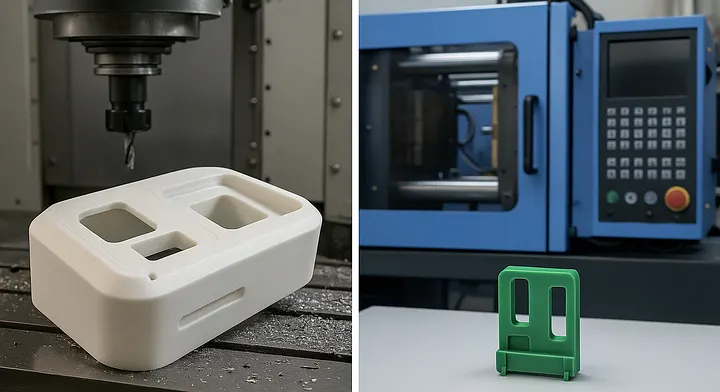
It’s a moment we’ve witnessed countless times in our years as a premier manufacturing partner. A brilliant innovator, an ambitious startup, or a seasoned R&D manager receives a quote for their first high-fidelity, physical prototype. They hold in their mind the target retail price of their final product-perhaps just a few dollars. Then they look at the quote for a single, perfect model and experience a moment of profound sticker shock.
The question that follows is not just fair; it is the most logical question one could ask without a deep view into the intricate mechanics of modern manufacturing:
“How can a single prototype possibly cost thousands of dollars when the final, mass-produced part will only cost two dollars? The math doesn’t make sense!”
This apparent discrepancy isn’t a miscalculation or an unfair markup. It is the reflection of a fundamental difference in purpose, process, and economics. Comparing the budget for a custom-made prototype to the price of a mass-produced part is a classic category error, much like comparing the commission fee for an original, hand-painted masterpiece to the price of a mass-market poster print of that same painting.
Though they may look identical, they are not the same product. One is the result of a bespoke, labor-intensive process of creation. The other is the result of a highly optimized, automated process of replication.
At IDMockup, we believe that transparency and education are the cornerstones of a great partnership. Our goal is not just to provide a price, but to provide clarity and context. This in-depth guide will deconstruct the hidden economics behind both the prototype and the production part. We will illuminate the complex, concentrated costs that go into crafting “the very first one,” and explain the magic of amortization that makes “the millionth one” so affordable.
Deconstructing the Cost of the “Original Masterpiece”: The Bespoke Prototype
First, it is essential to reframe what a prototype is. It is not simply a product; it is the physical embodiment of a high-end, custom service. When you commission a prototype from a professional firm like IDMockup, you are not buying a piece of plastic or metal. You are investing in a concentrated application of engineering expertise, advanced technology, and master-level craftsmanship. The entire cost of this complex process is focused on producing a single, perfect unit.
Let’s break down the hidden costs that are front-loaded onto that one prototype:
1. The Intellectual Setup: Engineering & Programming
Before a machine is ever turned on, a significant investment of skilled human hours takes place.
Design for Manufacturability (DFM) Review: Our experienced engineers will spend time meticulously analyzing your 3D CAD file. They are not just checking for errors; they are planning the entire manufacturing strategy. How should the part be oriented? What is the best machine to use? What is the optimal cutting tool strategy to achieve the required surface finish? This upfront intellectual labor prevents costly mistakes and ensures the highest quality outcome.
CAM Programming: A specialized CAM (Computer-Aided Manufacturing) programmer then takes over, spending several hours creating the precise toolpaths and G-code that will guide the CNC machine. For a complex 5-axis part, this is a highly skilled and time-consuming process, akin to a composer writing a symphony for the machine to perform.
2. The Physical Setup: Machine & Fixture Preparation
Once the digital instructions are ready, the physical setup begins.
Machine Allocation & Calibration: A multi-million-dollar 5-axis CNC machine-a piece of capital equipment designed for high-end production-is taken offline and dedicated entirely to your single part. A technician must calibrate the machine, load the correct cutting tools from a library of hundreds, and set the precise origins.
Custom Fixturing: Your unique part cannot simply be placed on the machine bed. It must be held in a custom fixture with absolute rigidity to withstand the forces of machining. Designing and creating this one-off fixture is a job in itself, requiring time and materials.
Material Preparation: A solid block of the specified engineering plastic or metal, often costing a significant amount itself, must be precisely cut and prepared.
All these hours of skilled labor and machine preparation are dedicated exclusively to producing your one part.
3. The Creation: Machining & Artisan Finishing
Machine Time: The CNC machine then begins its work, carving your design from the solid block. For a large or complex part, this can take many hours of continuous, supervised runtime.
Master Craftsmanship & Post-Processing: This is a crucial step that separates a professional prototype from a raw part. Once off the machine, the part moves to our finishing department. Here, a master craftsman will take over, performing a series of meticulous manual tasks:
- Deburring and Sanding: Removing any microscopic tool marks by hand, sanding through progressively finer grits to achieve a perfectly smooth surface.
- Priming and Painting: Applying multiple coats of primer and automotive-grade paint in a climate-controlled, dust-free spray booth to perfectly match your specified color and gloss level.
- Polishing and Texturing: For clear parts, this involves hours of hand-polishing to achieve optical clarity. For others, it might involve applying specific textures.
- Graphics and Assembly: Applying logos and text via silk-screening or pad printing, and performing any necessary sub-assembly.
Every cost outlined above-from the first engineering review to the final polish-is concentrated and borne by that single prototype. There is no 10,000th or 100,000th unit to help share this significant upfront burden. You are paying for the full, undivided cost of creation.
Deconstructing the Cost of the “Mass-Produced Print”: The Injection Molded Part
Now, let’s look at the world of the two-dollar part. How is it possible to produce something so inexpensively? The answer is the magic of scale and the economic principle of amortization. The process is designed to have an extremely high upfront cost, which is then spread so thinly across a massive number of units that it becomes almost invisible.
1. The Colossal Upfront Investment: The Production Mold (Tooling)
Before a single production part can be made, a company must invest in a production tool, which for plastics is a high-pressure injection mold. This is the Non-Recurring Engineering (NRE) cost, and it is the defining feature of mass production.
A Feat of Engineering: As our Rapid Tooling services show, this is not a simple device. It is a complex machine made from hardened tool steel, designed to withstand immense pressures (10,000+ PSI) and temperatures for hundreds of thousands of cycles. It contains precision-machined cavities, cooling channels, ejector systems, and often complex side-actions.
The Price of Durability: The cost to design and build such a mold is substantial, easily ranging from $20,000 for a simpler, rapid tool to well over $100,000 for a complex, multi-cavity production tool.
2. The Magic of Amortization: Hiding the Cost in Volume
This is the key to the entire economic model. This massive NRE cost is not paid for by the first part. Instead, it is divided across the entire production volume. Let’s do the math with a simple example:
- Mold Cost (NRE): $50,000
- Total Production Volume: 250,000 units
- Amortized Tooling Cost Per Part: $50,000 / 250,000 units = $0.20 per part.
Suddenly, the colossal $50,000 investment is reduced to just twenty cents per piece. This amortized cost is a “hidden” fraction of the final part’s price.
3. The Trivial Per-Part (Marginal) Cost
Once the mold is built and installed, the cost to produce each individual part is incredibly low.
- Material Cost: A few grams of a common thermoplastic pellet might cost only a few cents.
- Machine/Cycle Time: A highly automated injection molding press can produce a part every 15–30 seconds. The cost of this machine time and the electricity it consumes is fractional per part.
- Labor Cost: The process is almost entirely automated, requiring minimal human oversight. The labor cost per part is negligible.
So, the final $2 price of the production part might be composed of something like $0.15 in plastic material, $0.25 in machine time and labor, and $0.20 in the amortized cost of the mold, plus profit and overhead. The very thing that makes the prototype so expensive (the highly concentrated, non-amortized cost of its creation) is precisely what makes the production part so cheap (the highly diluted, amortized cost of its creation tool).
The Real Question: What is the True Value of a Prototype?
Understanding the cost is one thing; appreciating the value is another. The value of a high-fidelity prototype is not found in the material it’s made from. Its true, immense value lies in the financial risk it mitigates.
A prototype is a data-gathering tool. It is an investment in certainty. It provides definitive answers to the most expensive questions in product development:
- Does it assemble correctly?
- Is it ergonomically sound and user-friendly?
- Is it aesthetically appealing to stakeholders, investors, and test markets?
- Is it strong enough to survive its intended use?
Consider this: that $2,000 prototype that reveals a critical flaw in a snap-fit design is not an expense. It is the single greatest investment you can make, because it saves you from investing $50,000 in a faulty production mold and being saddled with a quarter-million worthless parts. It prevents catastrophic tooling redesign costs, months of delays, and irreparable damage to your market reputation. The prototype is not the cost of making one part; it’s the cost of ensuring that millions of future parts are perfect.
Conclusion: Creation vs. Replication — A Partnership for the Full Journey
Ultimately, attempting to measure the budget for a prototype using the price of a production part is a fundamental apples-and-oranges comparison. One is the bespoke cost of creation, the other is the scaled cost of replication.
Understanding this economic reality is the key to smart, successful product development. At IDMockup, our expertise covers this entire journey. We are masters of the meticulous, artisanal process of creating the first perfect prototype. And we are experts in designing, managing, and executing the efficient process of replicating that success through our advanced rapid tooling and injection molding services.
We encourage our clients to view prototyping not as a cost to be minimized, but as a strategic investment to be maximized. It is the most powerful tool you have for eliminating risk and ensuring the success of your final product. Partner with us, and let’s invest together in the certainty and excellence of your next great innovation-from the very first, perfect masterpiece to the millionth flawless copy.