
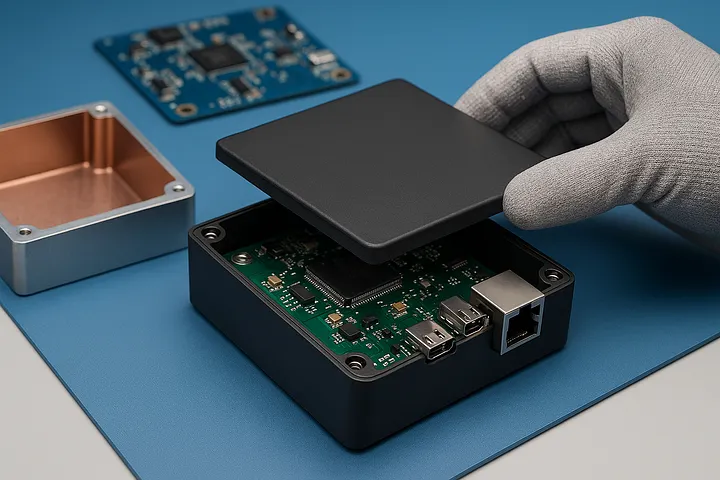
In the intricate world of electronics engineering, the most dangerous threats are often invisible. A microscopic crack in a solder joint, a subtle bug in a line of code, or a fleeting burst of electromagnetic interference can all wreak havoc. But perhaps the most insidious and destructive of these unseen forces is Electrostatic Discharge (ESD). A single, silent spark, often too small for a human to even feel, can carry thousands of volts of electricity-more than enough to instantly and permanently destroy the delicate micro-circuits at the heart of a processor, a sensor, or a memory chip.
Nowhere is this risk more acute than during the high-stakes prototyping and development phase. At this stage, you are often working with a single, priceless, and sometimes irreplaceable Printed Circuit Board Assembly (PCBA). This is the culmination of months of R&D, and it is incredibly vulnerable. The critical question for every diligent engineer and product manager is: how do you protect this sensitive “brain” when you place it inside a prototype enclosure for testing, validation, and demonstration? How do you ensure the very act of handling and testing the prototype doesn’t become the cause of its destruction?
This leads to a crucial question we often receive from our engineering clients at IDMockup & Precision Mold: “The enclosures you make are visually perfect, but can they provide the basic anti-static protection we need for safe handling and reliable testing?”
The answer is a resounding and emphatic yes. At IDMockup, we hold a core belief that a prototype must be more than just a pretty shell; it must be a functional, reliable, and safe engineering tool. We understand that a prototype’s most important job is to protect the invaluable electronics within. Through a strategic combination of material selection and our advanced, highly specialized surface processing capabilities, we transform standard enclosures into safe, static-aware housings, providing a critical layer of protection when it matters most.
This guide will take you deep into our process, revealing the techniques we have mastered over years of serving the electronics industry to provide this unseen, yet absolutely essential, layer of defense.
The Foundation: Material Selection and Its Inherent Electrical Properties
The journey to an ESD-safe enclosure begins with the foundational choice of material. The inherent electrical properties of the chosen metal or plastic create the baseline for the protective strategy.
The Natural Advantage of Metals (Aluminum & Steel)
For many of our clients in the industrial PC (IPC), server, and high-power communication sectors, the most robust and direct path to ESD and EMI protection is to use a metal enclosure. At IDMockup, our core competency in CNC Machining allows us to create intricate and durable enclosures from solid blocks of conductive metals like aircraft-grade aluminum alloys (6061, 7075) and stainless steel.
The principle at work here is as old as electromagnetic theory itself: the Faraday Cage. A continuous, conductive metal shell, when properly connected to the system’s electrical ground (e.g., through a mounting screw on the PCBA), creates a highly effective shield. This shield intercepts external electrostatic fields, causing the charge to remain on the exterior surface and flow safely to ground, rather than passing through to the sensitive components inside. This same principle also provides excellent protection against external Electromagnetic Interference (EMI) and Radio Frequency Interference (RFI), which is critical for communications equipment. For many demanding applications, a well-designed, precision-machined, and properly grounded aluminum enclosure is the first and best line of defense.
The Inherent Challenge of Plastics (ABS, PC, etc.)
However, for a vast number of consumer, commercial, and medical electronics, plastic is the material of choice due to its light weight, design flexibility, and lower cost. But standard engineering plastics like ABS, PC, and PMMA are excellent electrical insulators.
This insulating property presents a significant ESD challenge. Insulators do not allow electrical charge to flow easily. This means they are highly prone to triboelectric charging-the buildup of a static charge through friction (like being slid across a workbench or removed from a plastic bag). An insulating plastic enclosure can easily accumulate a charge of several thousand volts. Because it cannot dissipate this charge, it effectively becomes an ESD landmine. The next time a grounded object (like a person’s hand, or a cable) touches it, that stored energy can discharge in a sudden, destructive spark.
To overcome this challenge, we must move beyond the inherent properties of the material and into the world of advanced surface processing.
The Core Solution: Transforming Plastics with Functional Coatings
This is where IDMockup’s expertise truly sets us apart. Our state-of-the-art Surface Processing Department, renowned for its ability to deliver flawless, Class-A aesthetic finishes, is also a high-tech laboratory for applying a range of sophisticated functional coatings. We use the same precision and artistry required for a perfect paint job to impart specific electrical properties onto an otherwise insulating plastic part.
Method 1: Internal Conductive Shielding (Building a Faraday Cage for Plastics)
This is the industry-standard and most effective method for providing robust ESD and EMI protection to a plastic enclosure.
The Technology: We utilize specialized conductive paints, often referred to as EMI/RFI shielding coatings. These are advanced formulations consisting of a durable binder infused with finely milled, highly conductive metallic particles, most commonly nickel, copper, silver, or a combination thereof.
The IDMockup Process: Applying these coatings effectively is a multi-stage, precision process that goes far beyond a simple spray can.
- Aesthetic Finishing: First, the exterior of the enclosure is meticulously prepared and finished to the client’s exact cosmetic specifications-sanded, primed, and painted with the final color and texture.
- Precision Masking: This is a step of pure craftsmanship. Our highly skilled technicians then painstakingly mask off all exterior surfaces, connector openings, and any other areas that must not be coated. This precision masking is critical to ensure that the final product is both functional and beautiful.
- Interior Surface Preparation: The interior surface of the enclosure is then specially prepared (often with a light cleaning, scuffing, or adhesion promoter) to ensure a strong, permanent bond for the conductive coating.
- Controlled Application: In a dedicated, climate-controlled spray booth, the conductive coating is applied to a very specific and uniform thickness. We control this thickness down to the micron level, as it directly determines the coating’s final surface resistivity (measured in Ohms/square), and therefore, its shielding effectiveness.
The Resulting Functionality: This process creates a continuous, highly conductive layer on the entire interior surface of the plastic housing. The final step in the design is to ensure this conductive layer is connected to the PCBA’s electrical ground, typically via a screw, a conductive gasket, or a spring clip. Once this connection is made, the plastic enclosure is transformed into a highly effective Faraday Cage. It now provides the same fundamental ESD and EMI shielding benefits as a solid metal box, offering robust protection for the sensitive electronics within. This is particularly valuable for prototypes that need to undergo EMC (Electromagnetic Compatibility) pre-compliance testing, as it allows for realistic test results early in the development cycle.
Method 2: Surface Anti-Static / Static Dissipative Coatings
In some applications, the goal is not to create a perfect shield, but to prevent the buildup of static charge on the surface in the first place. This is where a different class of functional coating is used.
The Technology: Unlike a highly conductive paint which acts like a wire, an anti-static or static dissipative coating is engineered to have a specific, higher range of surface resistivity.
The Science of Safe Dissipation: The purpose of this coating is not to conduct current instantly, but to allow any static charge that accumulates on the surface to “bleed off” in a slow, controlled, and safe manner. It provides a path for the charge to migrate across the surface and dissipate harmlessly into the atmosphere or to a ground point if available. This prevents the charge from building up in one isolated spot to a voltage high enough to create a sudden, high-energy, and destructive spark when the device is touched.
The Ideal Application: This type of coating is perfect for the exterior of a device that is handled frequently, especially in an ESD-sensitive environment like a laboratory or a manufacturing line. It is the ideal solution for the housings of test equipment, diagnostic tools, assembly jigs, and any handheld electronic device where preventing the device itself from becoming a static charge source is a priority. This coating can be applied as a clear coat over the aesthetic finish, providing its functional benefit without altering the product’s appearance.
The IDMockup Advantage: It’s All in the Precision of the Process
It’s one thing to have access to these advanced coatings; it’s another thing entirely to apply them with the precision and repeatability that the electronics industry demands. The effectiveness of any functional coating is 100% dependent on the quality of its application.
Process Control is Everything: At IDMockup, our finishing department operates with the same process-driven, quality-controlled mindset as our CNC machine shop. We meticulously control every variable-from surface preparation and masking precision to the spray-gun parameters and coating thickness-to ensure that the specified electrical properties are achieved consistently across every part in a batch.
Integrated Expertise: Our greatest strength lies in our integrated workflow. The engineering team that reviews your CAD file for CNC machining is in constant communication with the finishing department. We can consult with you on the best design practices to ensure reliable grounding points for conductive coatings. We understand how to design and machine a part in a way that makes the subsequent finishing process more effective and reliable. This seamless integration of knowledge ensures a better final result.
Conclusion: A Prototype That Actively Protects Your Innovation
In the high-stakes world of electronics development, a prototype must be more than just a dimensional study. It must be a safe, stable, and reliable platform for testing and validation. An unprotected prototype is a liability, a source of risk that can lead to costly and demoralizing setbacks.
At IDMockup & Precision Mold, we address this challenge head-on. We provide a multi-pronged approach to ESD protection, from inherently safe, precision-machined metal enclosures to advanced functional coatings that transform insulating plastic housings into guardian shells.
A prototype from IDMockup is not just a pretty face. It is a carefully engineered tool, thoughtfully manufactured to protect the priceless, often irreplaceable, electronic heart within. It gives you the peace of mind to handle, test, and demonstrate your innovation with confidence. When you are ready to move your design from the screen to the test bench, don’t leave its safety to chance. Partner with IDMockup, and let us build you a prototype that not only looks the part but actively works to protect it.
Interested in learning more about our related manufacturing capabilities? Explore our CNC & EDM Machining, 3D Printing, Rapid Tooling & Injection Molding, Vacuum Casting (Soft Tooling), Reaction Injection Molding (RIM), and Metal Die Casting pages.