
We are living in a new epoch, one defined and driven by data. The explosive growth of cloud computing, big data analytics, and generative AI is fueled by the relentless, non-stop calculations occurring within tens of thousands of high-performance CPUs and GPUs housed in data centers across the globe. This powerful torrent of computational power, however, is accompanied by an inherent and severe challenge: the generation of an unprecedented tidal wave of thermal energy.
In this high-stakes environment, thermal management is no longer a secondary design consideration; it has become the life-or-death factor that dictates a server’s performance, long-term stability, and operational cost. A poorly designed or manufactured thermal module can lead to processor throttling and severe performance degradation at best. At worst, it can cause a catastrophic overheat-induced shutdown, resulting in incalculable business losses. Today, with individual server rack power consumption regularly exceeding the kilowatt threshold, the success or failure of the thermal design has become a core pillar of a product’s competitive advantage.
There exists a vast chasm between a thermal solution that performs perfectly in the clean, digital world of a simulation software and a physical module that can deliver that same performance reliably in the chaotic, real-world environment of a server chassis. Bridging this chasm requires the ability to create rapid, precise, and iteratively improved physical prototypes. It is this critical capability that we at IDMockup & Precision Mold have been providing for years, serving as a key R&D partner to the world’s leading networking and server manufacturers.
Deconstructing the Modern Thermal Module: A System of Synergistic Components
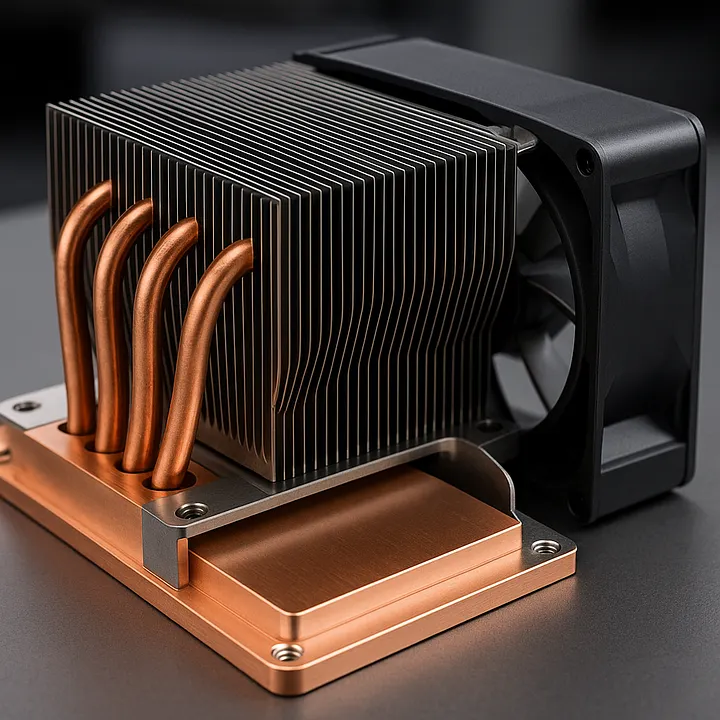
A modern server thermal module is a far cry from the simple, extruded aluminum heatsinks of the past. It is a highly integrated, precision-engineered system where each component must work in perfect harmony with the others. A typical high-performance module consists of:
- The Baseplate: This is the critical first point of contact, a copper or aluminum plate that sits directly on the CPU or GPU Integrated Heat Spreader (IHS). Its primary job is to absorb the intense, concentrated heat as quickly and efficiently as possible.
- The Heat Spreader: Because the heat is so concentrated, it must be rapidly “spread” over a larger area. This is the job of advanced heat transfer elements like Heat Pipes or, for higher power densities, Vapor Chambers (VCs). These sealed copper vessels use a phase-change cycle of an internal working fluid to move thermal energy with incredible speed.
- The Fin Stack: This is the “radiator” of the system. It is a dense array of thin metal fins, typically aluminum or copper, designed to provide a massive surface area for the heat to be transferred to the air.
- The Fan Shroud / Air Duct: This is the crucial air management component. It is a precisely shaped duct that channels the high-velocity airflow from the server’s fans directly through the fin stack, maximizing the efficiency of the heat exchange and preventing air from recirculating.
In this complex system, every micron of tolerance, every material property, and every assembly interface directly impacts the final thermal performance. A poorly machined baseplate can create insulating air gaps. An improperly seated heat pipe can create a thermal bottleneck. An ill-fitting fan shroud can allow precious airflow to escape. Our expertise at IDMockup lies in providing a complete manufacturing solution for the critical mechanical components of this system, from the first R&D prototype to low-volume production.
IDMockup’s Solution (Part 1): Forging the Core with High-Precision CNC Machining
The heatsink and its base are the soul of the entire thermal module. Our state-of-the-art CNC machining capabilities empower thermal engineers to transform their most aggressive and efficient designs into physical reality, far beyond the limits of traditional manufacturing.
1. Liberating Geometry: Moving Beyond the Constraints of Extrusion
Traditional heatsinks are made from aluminum extrusions, a process limited to creating linear fins of a uniform shape. For the demands of a modern, densely packed server, this is often insufficient. Our 3-axis and 5-axis CNC machines can start with a solid block of high-conductivity C1100 Copper or AL6061/AL6063 Aluminum and create geometries optimized for performance:
Complex Fin Designs: We can machine fins with unique profiles-tapered, flared, or contoured-to manipulate airflow, create turbulence, and maximize the heat transfer coefficient. We can create intricate patterns to fit around other components in a cramped 1U or 2U chassis.
High-Density Fin Stacks: We are able to prototype advanced heatsink designs like skived fin models, where a special tool shaves thin, high-density fins directly from a copper or aluminum base, creating a single, continuous piece with a superior thermal path.
2. The Gospel of Flatness: Mastering the Critical Thermal Interface
The efficiency of any thermal module begins at the point of contact. The interface between the module’s baseplate and the processor is the most critical link in the thermal chain. Even microscopic air gaps, invisible to the naked eye, act as powerful insulators, trapping heat and crippling performance.
Micron-Level Flatness: We have perfected the art of machining these critical surfaces. We can consistently control the flatness of the baseplate to within 0.01mm (10 microns). This, often combined with a lapped, mirror-smooth surface finish, dramatically reduces the thermal resistance of the interface, ensuring that the first step of the heat’s journey-from the chip to the heatsink-is as unobstructed as possible.
3. Engineering for Phase Change: Precision for Heat Pipes and Vapor Chambers
For the most demanding applications, advanced two-phase cooling devices like heat pipes and vapor chambers are essential. The performance of these devices depends on a perfect, hermetically sealed copper enclosure containing a wick structure and a working fluid under a vacuum.
Precision Cavities and Grooves: Our role in prototyping these devices is to machine the critical copper components with absolute precision. We use our CNC centers to machine the perfectly sized and positioned grooves in an aluminum or copper baseplate to house the heat pipes. For vapor chamber prototypes, we can machine the intricate internal support structures and micro-channel wick patterns directly into the copper plates that will form the chamber’s shell. Our strict tolerance control ensures that all these components fit together perfectly for the subsequent high-temperature brazing and assembly process, eliminating any gaps that could compromise the final seal and, therefore, the device’s performance.
IDMockup’s Solution (Part 2): A Multi-Process Approach to Mastering Airflow
An expertly crafted heatsink is useless if air doesn’t flow through it correctly. The fan shroud and any associated ducting are the critical levers for maximizing the efficiency of the entire system. We employ a strategic, multi-process approach to help engineers perfect their air management strategy.
1. Rapid Validation with SLA 3D Printing
In the early design stages, an engineer may have several competing theories for the most effective shroud or duct geometry. Building a tool or CNC machining each version would be slow and expensive.
The Agile Approach: SLA (Stereolithography) 3D Printing is the perfect tool for this phase. We can take multiple complex, organic shroud designs and print them in high-resolution resin overnight. This allows the engineering team to conduct rapid, back-to-back flow testing (in a wind tunnel or on a test bench) and check for mechanical interferences with other server components. This ability to test multiple physical iterations in a matter of days, at a very low cost, is an invaluable tool for finding the optimal design.
2. Robust Prototyping with CNC Machining
Once a design has been validated for its airflow characteristics, a more robust prototype is often needed for late-stage testing.
The Functional Prototype: For more rigorous thermal, acoustic, and vibration testing, a 3D-printed part may deform or crack under the high temperatures and stresses. At this stage, we use our CNC machines to create a functional prototype from a more durable and temperature-resistant engineering plastic, such as ABS or Polycarbonate (PC). This delivers a strong, stable part that can withstand the rigors of full-system validation testing.
The Core IDMockup Value: Accelerating Your Thermal R&D Cycle
In the development of a server thermal module, time is the most valuable currency. The market will not wait for a perfect product; it will reward the team that can iterate, learn, and optimize the fastest. The core value of partnering with IDMockup is, in a word, acceleration.
Accelerating the Simulation-to-Reality Loop: Your thermal engineer can finalize an optimized heatsink design in their CFD simulation software on a Monday afternoon. By partnering with us, they can have a physical, fully-machined CNC part, made from the correct material and to their exact specifications, in their hands for real-world bench testing later that same week. This dramatically shortens the cycle of learning.
Accelerating Design Iteration: The data from that first physical test may reveal an unexpected hotspot or airflow issue. No problem. A revised CAD file can be sent to us, and we can begin machining the second, improved iteration immediately. This ability to rapidly test, fail, learn, and correct is a development model that is simply impossible to achieve with traditional, slow-moving manufacturing methods.
Accelerating the Entire Project via Integrated Service: We can simultaneously provide the CNC-machined copper baseplate, the aluminum fin stack, and the SLA or CNC-machined plastic fan shroud. By acting as a single, integrated manufacturing partner, we eliminate the logistical complexity and potential delays of managing multiple, disparate vendors. We ensure all components are designed for manufacturability and that they will assemble together perfectly, accelerating your entire project timeline.
Conclusion: From Thermal Simulation to Cool Reality, We Are Your Bridge
Taming the staggering heat output of future servers is a complex, multi-disciplinary challenge at the intersection of material science, fluid dynamics, and precision manufacturing. Thermal simulation software provides the essential map for your journey. But it is IDMockup & Precision Mold that provides the powerful, high-speed vehicle to get you to your destination.
We are the essential bridge between the digital simulation and the physical, testable reality. We are the practitioners and accelerators who empower your engineering team to take their brilliant thermal designs out of the virtual world and prove them in the real one.
If your team is wrestling with the thermal challenges of the next generation of AI servers, data centers, or high-performance computers, we invite you to bring us your designs. Let’s discuss your challenges. Let our decades of experience and our micron-level precision craftsmanship help you tame the heatwave and build the cool, powerful, and reliable heart of the future.
Interested in learning more about our related manufacturing capabilities? Explore our CNC & EDM Machining, 3D Printing, Rapid Tooling & Injection Molding, Vacuum Casting (Soft Tooling), Reaction Injection Molding (RIM), and Metal Die Casting pages.