
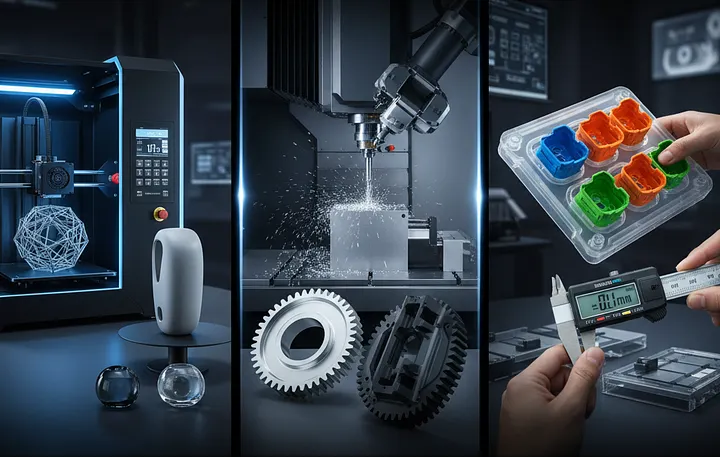
In the dynamic world of product development, the moment a digital design is finalized in CAD is one of both triumph and trepidation. The next step-transforming that intricate collection of pixels and vectors into a physical, tangible object-is one of the most critical decisions in the entire development lifecycle. Today, innovators are armed with a formidable arsenal of manufacturing technologies, each with its own unique strengths. The three most prominent champions of prototyping and low-volume production are 3D Printing, Vacuum Casting, and the venerable craft of CNC Machining.
This newfound accessibility of choice, however, presents its own challenge: a paradox of options. Which path do you take? When is the lightning speed of 3D printing the right call? When does the batch-replication power of vacuum casting make the most sense? And, most importantly, when do the uncompromising precision and material authenticity of CNC machining make it the necessary and superior choice?
This is a question we at IDMockup & Precision Mold address with our clients every single day. As a state-of-the-art facility that has mastered all three of these core technologies under one roof, we offer a unique, experience-driven, and unbiased perspective. We believe in empowering our clients with knowledge, guiding them to the manufacturing solution that best aligns with their project’s specific goals, budget, and technical demands.
This comprehensive guide will serve as your decision-making framework. We will explore the “sweet spot” for 3D printing and vacuum casting, and then delve deep into the four decisive scenarios where the power, precision, and performance of CNC machining make it the undisputed champion for bringing your vision to life without compromise.
Understanding the Alternatives: The Right Tool for a Specific Job
To appreciate when CNC is essential, we must first respect the powerful roles that 3D printing and vacuum casting play in the development ecosystem. They are not competing technologies, but complementary ones with distinct advantages.
1. 3D Printing (Stereolithography — SLA): The Sprinter of Innovation
The primary, undeniable advantage of 3D printing, particularly industrial SLA, is its unparalleled speed. It is the ultimate tool for the earliest stages of design verification, where rapid iteration is the key to success.
Choose 3D Printing When: You need to quickly validate the basic form, fit, and ergonomics of a design. When you have three different concepts for a handle and want to physically hold all three by tomorrow morning. When you need to check a multi-part assembly for major interferences. SLA can take a CAD file and produce a complex physical model overnight, a process that would have taken weeks just a decade ago.
The Critical Limitation: The materials used are photopolymer resins. While these resins have become incredibly advanced and can simulate the properties of common plastics like ABS or PC, they are not the real thing. Their mechanical strength, thermal resistance, and chemical compatibility are fundamentally different from production-grade thermoplastics or metals. For a quick look-and-feel model, this is acceptable. For rigorous functional testing, it provides unreliable data.
2. Vacuum Casting (Silicone Molding): The Multiplier for Market Testing
Vacuum casting serves as the perfect bridge between a single prototype and full-scale injection molding. It is a brilliant replication technology for small-batch production.
Choose Vacuum Casting When: You have a finalized design (often perfected using a CNC or SLA master pattern) and need a small batch of 10 to 50 high-quality copies. This is ideal for clinical trials of a medical device, for providing samples to a sales team, for a beta testing run with key users, or for a photo-ready lineup of your product in multiple colors.
The Critical Limitation: The process uses polyurethane (PU) resins that are expertly formulated to mimic a vast range of production plastics, from rigid ABS to flexible rubber. While the cosmetic finish is excellent, the material is still a simulant. Furthermore, the process relies on a flexible silicone mold. While great for complex parts, this “soft tooling” inherently has a larger dimensional tolerance (typically ±0.15mm/100mm) and is not suitable for parts requiring micron-level precision.
The Decisive Factors: Four Scenarios That Demand CNC Machining
Now, we arrive at the crossroads. The following four scenarios represent situations where the limitations of simulated materials and softer tooling are unacceptable. These are the domains where the precision, strength, and authenticity of CNC machining are not just preferable, but absolutely essential.
1. When Material Authenticity is Non-Negotiable: The Demand for “Real” Engineering Materials
This is the most fundamental reason to choose CNC. A prototype is often built to be tested, and for that test data to be valid, the prototype must behave identically to the final production part. This is only possible if it is made from the exact same material.
The Engineering Challenge: Imagine testing a new intake manifold for a performance engine. This part will be subjected to high temperatures, intense vibrations, and exposure to fuel and oil. A 3D-printed resin prototype would warp, melt, or dissolve under these conditions, providing zero useful data. Or, consider a medical instrument that must undergo repeated steam sterilization (autoclave). Only a prototype machined from a true medical-grade material like PEEK or 316L Stainless Steel can validate the design’s durability.
CNC’s Unmatched Solution: CNC machining is a subtractive process; it starts with a solid block of production-grade material and carves away the excess. At IDMockup, our CNC department is a library of real-world engineering materials. We machine parts from the very same plastics and metals our clients will use in mass production:
- Engineering Plastics: ABS, PC, PMMA (Acrylic), POM (Delrin®), PA66 (Nylon), PEEK, Ultem, and more.
- Metals: Aluminum alloys (6061-T6, 7075-T6), Stainless Steel (303, 304, 316L), Copper (C1100), Brass, Titanium, and Mild Steel.
3D printing and vacuum casting cannot offer this. They offer excellent simulations, but CNC offers authenticity. When your functional prototype needs to survive real-world forces, temperatures, and chemical exposure, CNC is the only path forward.
2. When Millimeters Become Microns: The Requirement for Extreme Precision and Tight Tolerances
While modern SLA 3D printing offers impressive accuracy, the world of high-performance engineering often operates on a level of precision that only machine tools can achieve.
The Engineering Challenge: Your part is a component in a Swiss watch, a gear in a robotic transmission, a lens holder in an optical assembly, or a sealing surface in a hydraulic manifold. In these applications, a deviation of 0.05mm (a typical best-case for 3D printing) is the difference between a perfect fit and total failure. These designs call for tolerances measured in microns (µm).
CNC’s Unmatched Solution: The principle of CNC machining-a rigidly held, computer-controlled cutting tool acting on a securely fixtured workpiece-is designed for precision. Our multi-axis CNC machining centers are calibrated to achieve breathtaking accuracy. While we can hold general tolerances comparable to injection molding, on critical features we can achieve tolerances of ±0.01mm (10 microns) or even tighter.
- Perfectly round bearing bores.
- Optically flat mating surfaces.
- Precisely located dowel pin holes.
- Sharp, clean threads.
This level of precision is impossible to achieve with the inherent shrinkage of photopolymers in 3D printing or the flexible nature of silicone molds in vacuum casting. When your design’s success is measured in microns, CNC is the only technology that can deliver the required certainty. At IDMockup, our quality control lab, equipped with advanced Coordinate Measuring Machines (CMM), verifies these dimensions, ensuring that the part you receive is a perfect physical manifestation of your digital design.
3. When Structural Integrity and Mechanical Performance are Paramount
A prototype is often built to be pushed to its limits. It needs to be subjected to stress, strain, impact, and vibration to find its breaking point, thereby validating the engineering behind it.
The Engineering Challenge: You’ve designed a new suspension component for a mountain bike, a mounting bracket for an aerospace application, or a protective housing for a ruggedized electronic device. You need to put this part on a test rig and subject it to real-world forces.
CNC’s Unmatched Solution: The mechanical properties of a CNC-machined part are the true, well-documented properties of the bulk material it was carved from. A part machined from a solid billet of 7075-T6 aluminum is homogenous, isotropic, and possesses the full, predictable strength of that alloy.
- No Layer Lines: Unlike FDM 3D prints, which have inherent weaknesses between their layers (anisotropy), a CNC part has no such structural flaws. Its strength is consistent in all directions.
- No Internal Stresses: Unlike molded or cured parts, a properly machined component has minimal internal stress, providing predictable performance under load.
This means that when a CNC prototype fails during destructive testing, the data is invaluable. It tells you that the design itself needs to be stronger. When a 3D-printed part fails, the cause is ambiguous-was it the design, or was it just the inherent weakness of the printing process? For meaningful structural and mechanical validation, CNC machining is the only way to test your design, not the prototype’s limitations.
4. When a Flawless Surface Finish is a Functional Requirement
In some applications, the surface of a part is not just for aesthetics; it is a critical functional feature.
The Engineering Challenge: The part you are prototyping is an optical lens or light pipe that requires crystal clarity. It could be a component in a medical fluidics device where perfectly smooth channels are needed to prevent turbulence or bacterial growth. Or, it might be a high-end consumer product where the final finish, like a “diamond-cut” edge on an aluminum housing, is a key part of its value proposition.
CNC’s Unmatched Solution: CNC machining provides a superior foundation for achieving virtually any surface finish. It can produce surfaces that are:
- Optically Clear: By machining materials like acrylic (PMMA) or polycarbonate (PC) and then handing them over to our master finishers for vapor polishing, we can achieve a level of transparency that rivals glass.
- Perfectly Smooth: For applications requiring laminar flow or perfect seals, a CNC-machined and lapped surface is the gold standard.
- Ready for Premium Finishes: A CNC-machined part is the ideal, non-porous substrate for high-end secondary finishes. This includes the flawless, Class-A surfaces required for automotive-grade painting, or the clean, uniform surface needed for beautiful and durable anodizing on aluminum.
While SLA can produce a smooth finish, it cannot match the optical clarity or the perfect flatness of a polished CNC part. Vacuum casting is limited to replicating the surface of its master pattern. For applications where the surface is the function, CNC machining is the only technology that provides the necessary level of control and perfection.
Conclusion: Making the Right Choice for a Successful Outcome
The modern manufacturing landscape offers a powerful toolbox for innovators. 3D printing is your high-speed tool for initial concepts. Vacuum casting is your small-batch multiplier for market testing. But when your project demands unwavering material authenticity, extreme dimensional precision, predictable structural performance, and flawless functional surfaces, the clear, definitive, and professional choice is CNC machining.
The ultimate advantage of partnering with a multi-disciplinary expert like IDMockup is that you don’t have to navigate this complex landscape alone. We don’t push a single technology; we provide a holistic solution. By taking the time to understand the unique goals and challenges of your project, our team of experienced engineers can guide you to the most efficient, cost-effective, and technically superior manufacturing path.
Your vision deserves to be realized without compromise. By understanding when to leverage the strengths of each technology, you can de-risk your development process, accelerate your time to market, and build a better final product. When the stakes are high and certainty is paramount, CNC machining is the craftsman’s choice, and we are the masters of the craft. Contact us to see how we can bring your next project to life with the precision and quality it deserves.