
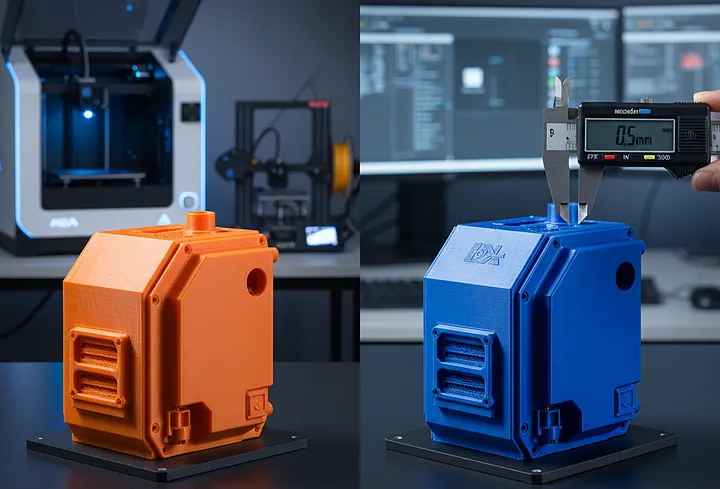
The world of 3D printing has undergone a breathtaking transformation. A technology once confined to the high-security R&D labs of aerospace and automotive giants is now more accessible than ever. Desktop Fused Deposition Modeling (FDM) printers, in particular, have become ubiquitous, humming away in workshops, design studios, and engineering labs across the globe. This democratization of additive manufacturing is a phenomenal leap forward, empowering creators to turn digital ideas into tangible objects with unprecedented ease. For quick, rough-and-ready conceptual models, the value of a desktop FDM printer is undeniable.
But a critical question arises when the mission changes. What happens when the goal shifts from simple ideation to serious, high-stakes product development? When a prototype is no longer just a placeholder, but a critical tool for engineering validation, ergonomic testing, and crucial stakeholder buy-in? At this pivotal stage, the choice of manufacturing technology transcends convenience and becomes a strategic decision that can dictate the success or failure of an entire project.
This is where the conversation pivots from the accessibility of FDM to the uncompromising precision of Stereolithography (SLA). For professional R&D personnel, whose work is measured in microns and whose success depends on data-driven certainty, industrial-grade SLA is not just a different choice; it is the only logical one.
As a comprehensive manufacturing partner offering a full spectrum of 3D printing technologies, including both FDM and advanced industrial SLA, we at IDMockup & Precision Mold are in a unique position. We don’t see this as a battle of technologies, but as a matter of selecting the right tool for a professional mission. Through years of collaboration with leading innovators across countless industries, we have seen firsthand why, when the results truly matter, the world’s most demanding R&D teams consistently turn to the superior capabilities of SLA.
This article will delve into the five critical criteria that R&D professionals prioritize, and conduct a head-to-head comparison to illuminate why SLA is the undisputed champion for professional-grade prototyping.
Defining the Battleground: The Core Concerns of the R&D Professional
Before comparing the technologies, we must first establish the metrics for evaluation. A professional engineer or designer assesses a prototype not just on its shape, but on its ability to provide reliable answers to critical questions. Their core concerns are:
- Dimensional Accuracy & Repeatability: Does the physical part faithfully represent the digital CAD model, down to the tightest tolerance? Can this accuracy be repeated consistently?
- Feature Resolution & Detail: Can the process reproduce the fine, intricate details that define a modern product, such as small textures, sharp edges, and delicate features?
- Surface Finish & Aesthetic Fidelity: Does the prototype look and, crucially, feel like a finished product, enabling valid ergonomic assessments and compelling presentations?
- Material Properties & Performance Simulation: How well can the prototype’s material mimic the mechanical or thermal properties of the final production material, allowing for meaningful functional tests?
- Isotropic Properties: Is the part’s structural strength consistent regardless of its orientation, providing predictable and reliable performance under stress?
With these five pillars of professional prototyping in mind, let’s explore how SLA and FDM measure up.
The Matter of Microns: Dimensional Accuracy & Repeatability
The FDM Reality
FDM technology builds parts by extruding a heated filament of thermoplastic through a nozzle, layer by layer. While ingenious, this mechanical process is subject to a host of variables that limit its precision. The nozzle’s diameter creates a minimum feature size, thermal expansion and contraction of the filament as it cools can cause warping, and the very nature of stacking semi-molten threads makes achieving tight tolerances a significant challenge. For a basic shape confirmation, this may suffice. But for an engineer needing to test the press-fit of a bearing or the seamless assembly of a multi-part enclosure, an FDM print often introduces too much uncertainty. The part might not fit because the design is wrong, or simply because the print itself is dimensionally inaccurate.
The SLA Advantage
SLA operates on a principle of light, not force. A highly focused UV laser beam with a minuscule spot size draws each layer in a vat of liquid photopolymer. This process is fundamentally more precise. The laser’s path is controlled with microscopic accuracy, and the curing of liquid resin is a far more controlled and predictable physical process than the cooling of extruded plastic. At IDMockup, our industrial-grade SLA systems consistently achieve tolerances of ±0.05mm.
What This Means for R&D
This level of precision is transformative. It means that when our clients receive an SLA prototype, they can have absolute confidence that they are holding a true physical replica of their digital design. When they conduct a fit-and-form test, they are testing their design, not the limitations of the printer. This confidence is the bedrock of an efficient development cycle, eliminating the costly guesswork and delays associated with lower-fidelity prototypes. For our clients in the medical device, aerospace, and high-end electronics industries, this isn’t a luxury; it is the price of admission.
2. Capturing the Nuances: Feature Resolution & Detail
The FDM Limitation
The resolution of an FDM printer is ultimately constrained by the physical size of the hole in its nozzle. It cannot create a feature that is smaller than this orifice. This makes it fundamentally incapable of reproducing the ultra-fine details that characterize sophisticated modern products. Crisp logos, delicate textures, small pins, sharp edges, and fine threads are often lost, rendered as indistinct approximations of the intended design.
The SLA Superiority
The resolution of an SLA printer is defined by the diameter of its laser beam, which is an order of magnitude smaller than an FDM nozzle. This allows SLA to achieve a level of detail that is simply astonishing. It can produce parts with razor-sharp edges, perfectly legible micro-text, and complex surface textures with incredible fidelity. At IDMockup, we routinely produce prototypes for networking equipment with intricate ventilation grilles, consumer products with delicate snap-fit features, and scientific instruments with fine, threaded components-all details that would be completely lost on an FDM print.
What This Means for R&D
The ability to see and test these fine details early in the process is invaluable. It allows for the validation of critical functional features (like seals and connectors) and ensures that the final product’s aesthetic and branding elements are perfectly executed long before any commitment is made to expensive tooling.
3. The Look and Feel of Reality: Surface Finish & Aesthetic Fidelity
The FDM Drawback
The most recognizable characteristic of an FDM print is its prominent, ridged layer lines. This “z-banding” is an unavoidable artifact of its layer-by-layer extrusion process. This isn’t just a cosmetic issue; it’s a functional one. A rough, ridged surface cannot provide valid ergonomic feedback-it simply doesn’t feel like a smooth, professionally manufactured product. Furthermore, these layer lines make post-processing for aesthetic purposes a laborious and often unsatisfactory chore, requiring extensive sanding and filling that can compromise the part’s accuracy.
The SLA Elegance
Because SLA solidifies layers of liquid resin, the transition between layers is incredibly subtle, resulting in a part with a smooth, almost glassy surface finish straight out of the machine. It closely mimics the look and feel of a production-quality injection-molded part.
What This Means for R&D
This is where the true value of partnering with a professional service like IDMockup becomes evident. For us, a pristine SLA print is merely the canvas. Our true expertise is showcased in our master-level post-processing and finishing department. Our artisans take these already-smooth parts and elevate them to flawless, presentation-grade models. Through meticulous hand-sanding, expert priming, and the application of automotive-grade paints custom-matched to any color code, we deliver prototypes that are visually indistinguishable from the final product. These models can go directly from our facility into a crucial boardroom presentation, a high-stakes investor pitch, or a professional marketing photoshoot. This level of aesthetic fidelity provides unparalleled confidence and helps accelerate the decision-making process at every level of an organization.
4. Simulating the Real World: Material Properties & Performance
FDM’s Materials
FDM offers a good variety of well-known thermoplastics like PLA, ABS, and PETG. These are excellent general-purpose materials, but they represent a limited palette for engineers needing to simulate the performance of more specialized production plastics.
SLA’s Specialized Resins
The field of photopolymer chemistry is one of rapid innovation. SLA technology is supported by a vast and growing library of specialized resins engineered to mimic the properties of end-use thermoplastics. At IDMockup, we offer a wide range of these advanced materials, including:
- Durable resins that simulate the strength and stiffness of ABS.
- Tough resins that mimic the impact resistance of Polycarbonate (PC).
- Optically clear resins for prototyping lenses and light pipes, which can be polished to near-perfect transparency.
- High-temperature resins that can withstand heat, allowing for testing in more demanding thermal environments.
What This Means for R&D
The ability to choose a prototype material that closely matches the intended production material allows for more meaningful and reliable functional testing. An R&D team can perform snap-fit cycle tests, drop tests, or even basic fluid-flow and thermal tests with a much higher degree of confidence that the results will translate to the final product. Our engineers work closely with clients to understand their functional requirements and select the perfect resin to ensure their testing yields the most valuable data.
5. The Anisotropy Problem: Strength in Every Direction
This is perhaps the most critical, yet least understood, distinction for engineering applications.
FDM’s Weakness (Anisotropy)
Because FDM parts are built by stacking individual threads, the bond between the layers (on the Z-axis) is a mechanical adhesion that is significantly weaker than the strength of the plastic filament itself (on the X-Y plane). The part is anisotropic. This means its strength is unpredictable and highly dependent on its orientation during printing. A part that seems strong when pulled along its printed length can snap with surprising ease when force is applied across its layer lines. For any prototype intended for load-bearing or functional testing, this is a fatal flaw. The part could fail not because the design is weak, but because the prototype itself has a built-in, invisible weakness.
SLA’s Strength (Isotropy)
The SLA process works differently. As the laser cures the liquid resin, it creates strong, covalent chemical bonds. The layers are chemically fused, not just mechanically stacked. The resulting part is far more isotropic, meaning its mechanical properties-tensile strength, stiffness, and impact resistance-are much more consistent and predictable in all directions.
What This Means for R&D
Predictable performance is paramount for engineering validation. The isotropic nature of our industrial SLA parts means that when our clients test a prototype, they are getting a true assessment of their design’s structural integrity. They are not being misled by the inherent weaknesses of the manufacturing process. This reliability is non-negotiable for serious R&D.
Conclusion: The Right Tool for a Professional Mission
The choice between FDM and SLA is not merely a matter of good versus bad; it is a matter of professional versus prosumer. FDM has masterfully filled the role of a quick, low-cost tool for basic concept visualization, and it excels in that capacity.
However, the rigorous demands of professional product development-a world built on tight tolerances, fine details, authentic user feedback, meaningful functional testing, and predictable structural performance-require a more advanced solution. Across every key criterion that a professional engineer or designer holds dear, industrial-grade SLA proves to be the superior technology.
At IDMockup & Precision Mold, we are committed to empowering innovation. We provide the tools, the materials, and most importantly, the expertise to help our clients navigate their development journey with confidence. While we offer FDM for those early, rough-concept needs, we guide our professional R&D clients toward our industrial SLA services for their high-stakes validation. We believe that your groundbreaking ideas deserve to be represented by prototypes of equal caliber.
Don’t let the limitations of a desktop printer define the potential of your next great product. Partner with a team that understands the demands of your mission. Contact our engineering specialists to discover how our professional SLA services, backed by unparalleled finishing expertise, can accelerate your innovation, de-risk your development, and bring your vision to life with the precision it deserves.