
In the hyper-competitive landscape of the 21st century, the journey from a groundbreaking idea to a market-ready product is a high-stakes race against time, cost, and convention. Innovators, engineers, and designers are in a constant battle to bring their vision to life faster, more efficiently, and with greater certainty than ever before. This journey is fraught with peril; the chasm between a digital CAD model and a successful physical product is vast, filled with potential pitfalls of flawed ergonomics, unforeseen assembly issues, and aesthetic miscalculations.
For decades, the traditional path of product development was paved with slow, expensive, and unforgiving methods. Creating a physical prototype often meant investing tens of thousands of dollars and waiting weeks, or even months, for subtractive machining or the creation of preliminary tooling. A single design flaw discovered at this stage was not just a setback; it was a catastrophic blow to budgets and timelines. The freedom to experiment, to iterate, and to perfect was a luxury few could afford.
But today, that paradigm has been shattered. A revolutionary technology has emerged as the definitive catalyst for modern innovation: Stereolithography (SLA) 3D Printing. This advanced additive manufacturing process has fundamentally transformed the early stages of product development, turning the once-prohibitive practice of prototyping into a rapid, precise, and accessible engine for creation.
At IDMockup & Precision Mold, we haven’t just witnessed this revolution; we have been at its forefront for years. We’ve harnessed the power of industrial-grade SLA technology to help countless clients-from nimble startups to global industry leaders-navigate the treacherous waters of product development with newfound speed and confidence. This article will explore the profound impact of SLA, delving into why this specific technology is not just an option, but an absolute necessity for anyone serious about bringing a successful product to market. We will uncover how its core attributes, combined with our specialized expertise, create an unparalleled advantage in the most critical phase of innovation.
The Foundation of Fidelity: What is SLA and Why is it the Professional’s Choice?
Before we explore its strategic importance, it’s essential to understand what makes SLA a class apart from other 3D printing technologies. While the term “3D printing” has become a household name, often associated with the filament-extruding (FDM) printers found in schools and workshops, industrial SLA operates on a completely different level of precision and quality.
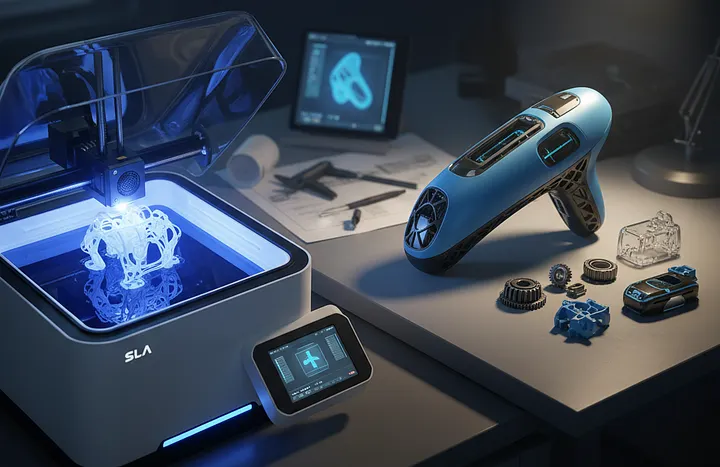
SLA is a photopolymerization process. It begins with a vat of liquid, light-sensitive resin (a photopolymer). A high-precision ultraviolet (UV) laser, guided by the product’s 3D CAD data, draws the first layer of the object onto the surface of the resin, instantly curing and solidifying it. The build platform then lowers by a fraction of a millimeter, and the laser draws the next layer. This process is repeated, layer by minuscule layer, until the entire solid object is materialized from the liquid.
The result is a part with a cohesive, isotropic structure and a surface finish that is exceptionally smooth, closely resembling a finished injection-molded part. This stands in stark contrast to FDM printing, which melts and extrudes a plastic filament. While FDM is excellent for hobbyists and producing very basic, low-fidelity concepts, its inherent process creates noticeable layer lines, results in a rough “stair-stepping” effect on curved surfaces, and struggles to reproduce the fine, intricate details that professional products demand.
For a product engineer who needs to verify the fit of a complex assembly, or a designer who needs to feel the subtle ergonomic curve of a handle, the difference is night and day. SLA produces parts with a dimensional accuracy we can hold to ±0.05mm, a level of precision that provides true, reliable, and actionable feedback. This is why, in the world of professional product development, SLA is the undisputed gold standard.
The Four Pillars of SLA’s Dominance in Early-Stage Development
The strategic importance of SLA in the initial phases of product development can be understood by examining four powerful pillars. These are not just technical features, but profound business advantages that directly impact a project’s outcome.
Pillar I: Unparalleled Speed & The Power of Rapid Iteration
In today’s market, speed is everything. The ability to iterate on a design-to physically test it, identify flaws, refine the CAD model, and test it again-is the single most important factor in achieving a superior final product. The faster and more frequently you can cycle through this “design-print-test-refine” loop, the more refined and market-ready your product will be.
Traditional prototyping methods make this loop agonizingly slow and expensive. Machining a complex part can take a week or more. Creating a soft tool for a small batch can take several weeks. With this timeline, a development team might only get two or three iterations before a deadline, forcing them to compromise and live with known imperfections.
SLA obliterates these constraints. At IDMockup, our workflow is optimized for velocity. A client can send us a finalized CAD file in the afternoon, and thanks to our high-speed machines and 24/7 operation, they can have a complex, high-resolution physical model on their desk the very next morning.
This incredible speed does more than just shorten the timeline; it fundamentally changes the nature of design itself. It fosters a culture of fearless experimentation. Designers can test three different grip designs simultaneously instead of betting on just one. Engineers can print and test an assembly with slightly different tolerances to find the perfect fit. This ability to get near-instant physical feedback transforms the development process from a linear, high-risk path into a dynamic, flexible, and creative spiral of continuous improvement. The result is a better product, achieved in a fraction of the time, giving our clients a decisive edge over their competition.
Pillar II: Absolute Precision & The Confidence of High-Fidelity Validation
A prototype is useless if it doesn’t accurately represent the final product. Its primary purpose is to provide data and confidence, allowing teams to validate critical aspects of the design before committing to the massive expense of mass-production tooling. This is where SLA’s high fidelity is not just a benefit, but a necessity.
What, specifically, are our clients validating with our SLA models?
- Form & Fit Assembly: In any product with more than one part, the most critical test is assembly. Do the interlocking parts snap together as intended? Are the clearances and tolerances correct to allow for movement without friction? Is there any unforeseen interference? An IDMockup SLA prototype, with its ±0.05mm accuracy, provides definitive answers to these questions. It allows engineers to perform a full mechanical validation, ensuring that when the product hits the assembly line, everything fits perfectly.
- Ergonomics and User Experience: How a product feels in the hand is a crucial, yet often subjective, factor. A CAD model on a screen can never convey the weight, balance, and tactile sensation of a physical object. The exceptionally smooth surface of an SLA model allows designers, clients, and test users to experience the product’s ergonomics authentically. They can feel the subtle contours of a handle, the placement of buttons, and the overall comfort, providing invaluable feedback that can make or break a product’s success.
- Aesthetic Confirmation: A product must not only work well; it must look right. It must embody the brand’s aesthetic and appeal to the consumer. The smooth, seamless surface of an SLA part provides the perfect canvas for aesthetic validation.
This is where the expertise of IDMockup truly shines. For us, the raw 3D print is merely the beginning of the journey. Our true advantage lies in our world-class post-processing and finishing department. Our master craftsmen take these high-resolution prints and transform them into presentation-grade models that are often indistinguishable from the final product. Through meticulous sanding, priming, custom color-matching to any Pantone or sample, and the application of flawless paint finishes-be it high-gloss, matte, or textured-we bring the product’s final look to life. We can add logos via silk-screening, create realistic transparent or tinted parts, and even perform complex assembly. The deliverable is not just a “prototype”; it’s a high-fidelity replica that can be used with confidence in boardrooms, at trade shows, and for crucial marketing photography.
Pillar III: Geometric Freedom & The Liberation of Design
For centuries, the creativity of a designer was constrained by the limitations of traditional manufacturing. The question was always, “Can this actually be made?” Subtractive methods like CNC machining struggle with deep internal channels or features that a tool cannot reach. Injection molding requires careful consideration of draft angles and cannot produce undercuts without complex, costly side-actions in the mold.
SLA, as a layer-by-layer additive process, liberates designers from these shackles. If you can design it in CAD, we can almost certainly build it. This opens the door to a new world of possibilities:
- Complex Internal Geometries: Designers can create parts with intricate internal channels for airflow or fluidics, or complex lattice structures to reduce weight while maintaining strength. This is invaluable in industries like medical devices, aerospace, and high-performance automotive.
- Organic and Biomimetic Shapes: Nature doesn’t design in straight lines, and with SLA, neither do you have to. Complex, flowing, organic curves that are optimized for ergonomics or aesthetics can be produced with perfect fidelity.
- Consolidation of Parts: Previously, a complex assembly might have required five separate, traditionally manufactured parts to be bolted together. With the geometric freedom of SLA, it can often be redesigned and printed as a single, stronger, and more lightweight monolithic part.
At IDMockup, we see ourselves as partners in our clients’ innovation. Our advanced fleet of SLA machines, operated by highly experienced technicians, is ready to tackle the most ambitious designs. We empower designers and engineers to focus on the optimal solution for the problem at hand, without being prematurely constrained by the “how-to-make-it” dilemma.
Pillar IV: Economic Efficiency & The Strategic Mitigation of Risk
At first glance, the cost of a single, high-quality SLA prototype might seem significant. But to compare it to the per-unit cost of a mass-produced part is to fundamentally misunderstand its value. The true economic power of an SLA prototype lies in the immense financial risk it mitigates.
Consider the cost of a production-quality steel injection mold. Depending on its complexity, this can easily range from $20,000 to over $100,000. This is a massive, non-refundable capital investment. Now, imagine discovering a critical design flaw-a snap-fit that breaks, a housing that doesn’t align, or a button that’s impossible to press-after this tooling has been cut. The cost is not just the lost investment in the mold, but the months of delays, the redesign costs, and the missed market opportunities. It is a corporate disaster.
An SLA prototype from IDMockup is the most effective and affordable insurance policy against this disaster. For a tiny fraction of the cost of production tooling, you can receive a physically perfect, testable model that allows you to discover and rectify every single one of those potential flaws when the cost of change is still near zero. You can validate every assumption and move forward to the tooling stage with absolute confidence.
By partnering with IDMockup, you are not just purchasing a model; you are investing in a strategic risk mitigation process. Our reliable, accurate, and beautifully finished prototypes provide the tangible data and unwavering confidence you need to make sound engineering and business decisions, ensuring your path to mass production is smooth, predictable, and successful.
Conclusion: Your Vision, Precisely Engineered
The four pillars-Speed for rapid iteration, Precision for high-fidelity validation, Complexity for unconstrained innovation, and Cost-effectiveness for strategic risk mitigation-combine to make SLA 3D printing the indispensable cornerstone of modern product development.
In this new era of innovation, having access to SLA technology is no longer a luxury; it is a prerequisite for success. But technology alone is not enough. The true advantage comes from partnering with a team that has mastered this technology and integrated it into a seamless, end-to-end service workflow.
At IDMockup & Precision Mold, we have built our reputation on this very principle. We combine the world’s most advanced SLA machines with the irreplaceable skill of our master finishers and the deep experience of our engineering team. We are more than a supplier; we are a strategic partner, dedicated to helping you bridge the gap between concept and creation. We invite you to bring us your next great idea, and let us show you how we can help you build the future, precisely.