
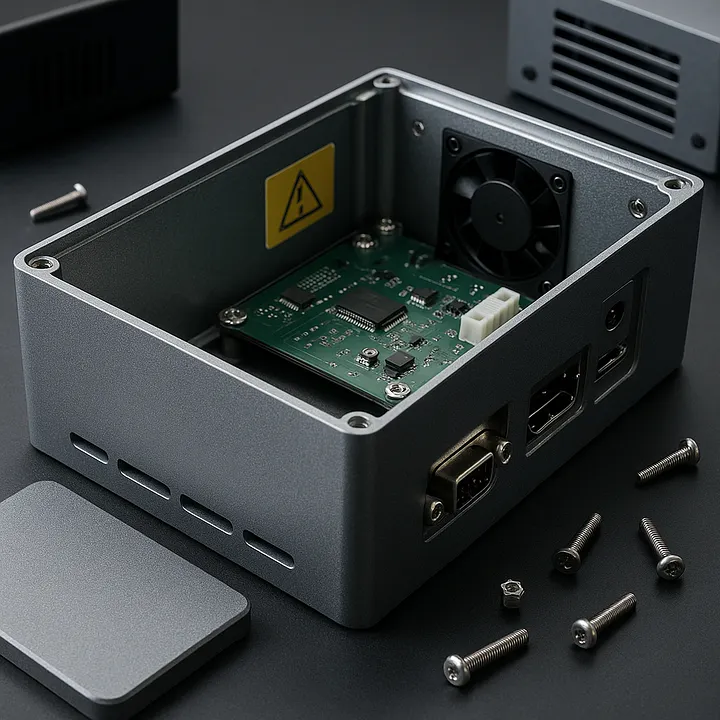
In the intricate world of electronics design, every component serves a purpose. The processor provides the brains, the memory provides the recall, and the power supply provides the lifeblood. The enclosure, the physical shell that houses these components, is often perceived as having two primary jobs: first, an aesthetic one-to look appealing and represent the brand-and second, a mechanical one-to ensure everything fits together perfectly.
But there is a third, silent, and arguably most critical job that every enclosure must perform: the job of safety. In a world powered by electricity, the potential for heat, short circuits, and fire is an ever-present reality. A well-designed and properly manufactured enclosure is the first and last line of physical defense. It is the component tasked with ensuring that a small, internal component failure does not cascade into a catastrophic event.
At IDMockup & Precision Mold, we have spent years working alongside the world’s leading electronics innovators. We understand that for a professional prototype, safety is not an afterthought; it is a core functional requirement. When our clients ask, “How can the prototype you build for us provide the necessary fire resistance and structural integrity for safe and reliable testing?”, our answer is rooted in a deep, multi-layered manufacturing philosophy.
We approach the safety of an enclosure not as a single feature, but as a Hierarchy of Safety. This is a series of strategic decisions and manufacturing processes, starting with the most fundamental material choices and building up to the finest finishing details. This guide will walk you through that hierarchy, explaining how our comprehensive suite of technologies addresses safety at every level to deliver a prototype that is not just a model, but a robust engineering tool.
Level 1: The Foundational Choice — Inherent Material Properties
The journey to a safe enclosure begins with the most fundamental decision: the material it will be made from. The inherent properties of this material will define its behavior in the face of a thermal event.
Option A: The Fortress of Metal (Aluminum & Steel)
For high-power applications such as industrial PCs, server equipment, and power supply units, the most direct path to fire safety is the use of a metal enclosure. Our expertise in CNC Machining and Sheet Metal Fabrication allows us to craft these metallic fortresses with absolute precision.
Inherent Non-Combustibility: The physics are simple and undeniable. Metals like aluminum and steel do not burn. This is the highest level of fire resistance a material can offer. They will not contribute fuel to a fire, which is the primary objective in containing an electrical event.
High Melting Points: While both are non-combustible, they offer different levels of thermal endurance. Aluminum alloys, which we frequently machine, have a melting point of around 660°C (1220°F). Steel, used for more demanding applications, has a much higher melting point of around 1370–1540°C (2500–2800°F). This means a steel enclosure can maintain its structural integrity for a much longer period in a fire, providing critical time for safety systems to engage.
Thermal Conductivity: Metals, particularly aluminum, are excellent thermal conductors. This is a crucial proactive safety feature. By effectively spreading heat across the entire surface of the enclosure, it acts as a large heatsink, pulling thermal energy away from potential hotspots on the PCB or power components. This helps to prevent components from reaching their auto-ignition temperature in the first place.
At IDMockup, our ability to machine complex enclosures from a solid block of aluminum or fabricate robust steel chassis provides our clients with the most robust possible foundation for fire safety.
Option B: The Intelligent Plastic — Specifying Certified Fire-Retardant Grades
For the vast majority of consumer and commercial electronics, plastic is the material of choice. Standard plastics, however, can be flammable. This is where material science and a deep knowledge of polymer grades become critical.
Understanding the UL94 Standard: The globally recognized standard for the fire safety of plastics is UL94. It is a vertical burn test that rates a material’s ability to self-extinguish after being ignited. For electronics enclosures, the most commonly specified (and desirable) rating is V-0.
What UL94-V-0 Means: In a controlled test, a vertical sample of the plastic is ignited for 10 seconds. For a V-0 rating, the flame must self-extinguish within 10 seconds, and no flaming drips are allowed that could ignite cotton placed below.
IDMockup’s Material Expertise: We are not just a plastic machining shop; we are material consultants. We have extensive experience sourcing and, crucially, properly machining a wide range of certified UL94-V-0 rated engineering plastics. This includes specific grades of FR-ABS, PC/ABS, and Polycarbonate (PC). Machining these materials can be different from their standard counterparts, and our technicians have the expertise to handle them without compromising their properties.
By guiding our clients to select a certified V-0 material from the very beginning, we ensure that the prototype has the same fire-retardant properties as the final, mass-produced product. This is non-negotiable for any device seeking regulatory approval and is a core part of our commitment to building safe, reliable prototypes.
Level 2: The Engineering of Integrity — Structural Design & Fabrication Quality
Choosing a fire-retardant material is the first step, but a strong material in a weak structure can still fail. The next level of the hierarchy is ensuring the enclosure is mechanically robust enough to contain an internal failure event. This could be the small, sharp pressure pulse from an exploding capacitor or the physical stress of warping components during an overheating event.
The Importance of Wall Thickness & Reinforcement: Our multi-axis CNC machining capabilities allow us to go beyond simple, uniform-walled boxes. We can work with our clients to machine enclosures with strategically thickened walls in critical areas and to integrate reinforcing ribs directly into the part. This creates a monolithic, incredibly strong structure that resists deformation and bursting.
The Criticality of Seams and Welds: In a sheet metal enclosure, the seams are the most likely point of failure in a fire. A simple spot-welded or poorly fabricated seam can easily split open, allowing flames to escape. At IDMockup, we address this with:
- Precision Bending: Our CNC press brakes create clean, accurate bends that ensure a tight fit between panels, minimizing gaps.
- High-Quality Continuous Welding: For applications demanding high integrity, our certified welders employ techniques like TIG welding to create continuous, fully penetrated seams that are as strong and fire-resistant as the parent metal. We build a box that stays a box.
Secure Fastening and Assembly: The design and fabrication of fastening points are also critical. We machine precise, deep-threaded holes and robust mounting bosses that ensure all panels are securely fastened. This prevents a panel from being blown off by a small internal pressure event, maintaining the integrity of the containment.
Level 3: Proactive Prevention — The Role of Meticulous Thermal Management
The safest fire is the one that never starts. In electronics, the vast majority of fire risks originate from a single cause: excessive heat. Therefore, a manufacturing strategy that enables effective thermal management is, in itself, a primary fire prevention strategy.
Manufacturing for Heat Dissipation
We collaborate closely with our clients’ thermal engineers to turn their CFD (Computational Fluid Dynamics) simulations into physical reality.
Custom Heatsinks: Our CNC machines are perfectly suited for creating custom aluminum or copper heatsinks. We can machine high-density fin stacks, complex airflow channels, and perfectly flat mounting surfaces to ensure optimal thermal transfer from a hot component to the heatsink.
Precision Airflow Management: An enclosure’s ventilation is a carefully engineered system. We use our CNC mills and laser cutters to create ventilation patterns with absolute precision. More than just holes, we can machine fan plenums, ducting features, and beveled entries/exits that ensure the cooling airflow behaves exactly as it was designed to in the simulation. We make sure the physical prototype perfectly matches the thermal model.
Using the Enclosure as a Heatsink: By ensuring perfect contact between internal heat-generating components (like a CPU) and the wall of a machined aluminum enclosure, we help our clients use the entire body of their product as a passive heat dissipator. This proactive approach to cooling is a powerful tool in preventing the dangerous overheating that can lead to a fire.
Level 4: The Final Details — Finishing Touches that Enhance Safety
The top of the safety hierarchy is composed of the final details that complete the protective ecosystem. These are often addressed during our surface processing and assembly stages.
Secure Component Mounting: A loose PCB or a vibrating power supply is a recipe for a short circuit. Our commitment to precision ensures that every internal mounting boss, standoff, and bracket we manufacture is perfectly located and dimensionally accurate, guaranteeing that all internal components are held securely in place, exactly as the designer intended.
Durable and Clear Safety Labeling: Regulatory compliance often requires permanent safety warnings, electrical ratings, and other critical information to be displayed on the enclosure. Our surface processing department provides durable silk-screening and precise laser engraving to apply these markings in a way that will not wear off over the life of the product.
Conclusion: A Holistic Approach to Building Safer Products
A truly safe electronic product is the result of a holistic development process, where safety is not a feature to be added at the end, but a principle that is engineered in from the very beginning. The quality of the manufacturing and the expertise of the manufacturing partner play an indispensable role in bringing that safe design to life.
At IDMockup & Precision Mold, we understand that our role in this process carries significant responsibility. We have built our reputation on a multi-layered approach to safety, ensuring we provide expert guidance and precision execution at every level of the hierarchy:
- We begin with a foundation of inherently safe or certified fire-retardant materials.
- We build upon it with robust structural integrity engineered through superior fabrication quality.
- We enhance it with proactive fire prevention through meticulous thermal management solutions.
- We complete it with the fine details that ensure reliable assembly and clear communication.
Don’t treat your product’s enclosure as a simple commodity. Treat it as the critical safety system it is. Partner with a manufacturer who shares that philosophy and has the technical depth to execute on it. Contact IDMockup to build your next prototype with safety, precision, and quality engineered into its very core.
Interested in learning more about our related manufacturing capabilities? Explore our CNC & EDM Machining, 3D Printing, Rapid Tooling & Injection Molding, Vacuum Casting (Soft Tooling), Reaction Injection Molding (RIM), and Metal Die Casting pages.