
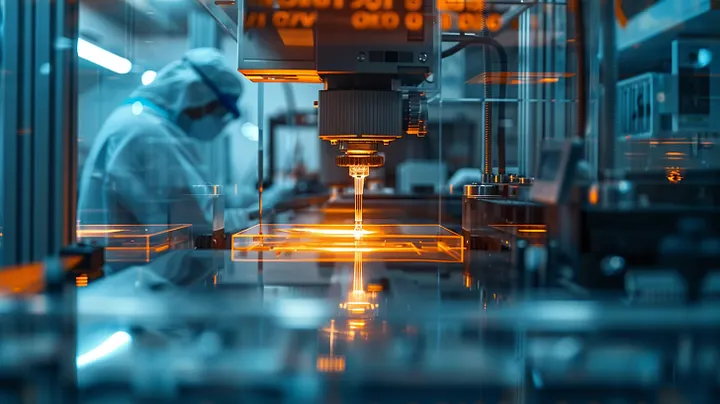
SLA (Stereo Lithography Appearance) 3D printing technology holds a significant position in industrial-grade 3D printing. SLA uses high-powered lasers to solidify liquid resin layer by layer to construct solid 3D models, offering exceptional accuracy. The laser beam focuses on the surface of the photopolymer resin, solidifying it from point to line, from line to surface, layer by layer, forming a three-dimensional entity.
The Benefits of SLA Technology in Key Industries
Medical Equipment
In medical device manufacturing, SLA technology can produce highly precise and complex parts such as surgical tools and implants. These devices require extreme accuracy, and the high resolution and fine detail of SLA technology meet these requirements perfectly. Moreover, SLA can quickly create customized medical products, enhancing the efficiency of medical equipment R&D and production.
Semiconductor
The semiconductor industry demands highly precise manufacturing techniques to ensure the performance and quality of chips and other components. SLA technology can accurately create small and complex semiconductor parts with high material utilization, reducing waste and lowering costs.
Electronics
In electronics manufacturing, SLA technology is used for rapid prototyping of high-precision functional samples. This helps shorten the product development cycle, quickly validate designs, and make timely adjustments, accelerating the time-to-market.
Communication Equipment
SLA technology provides high resolution and precision in producing precise components for communication equipment, ensuring the performance and stability of the devices. Parts produced by SLA can better withstand the high-frequency usage environment of communication equipment, extending product life.
Servers and Cooling
Servers and cooling devices require components with excellent heat dissipation and high durability. SLA technology can produce complex structures with these characteristics, ensuring stable operation and effective cooling of servers.
Green Energy and Electric Vehicles
The green energy and electric vehicle industries require many precise and lightweight parts. The high precision and material versatility of SLA technology enable the production of high-performance, environmentally friendly components, supporting the development of green energy and electric vehicles.
Comparing SLA with Other 3D Printing Technologies
DLP (Digital Light Processing Printing)
DLP uses a digital projector to project the entire platform without using lasers. Although DLP printing is faster, the models tend to be fragile or deformed, with a wavy texture on the surface. In contrast, SLA offers higher resolution and finer details.
FDM (Fused Deposition Modeling Printing)
FDM uses thermoplastic filament material that is melted and extruded layer by layer. However, FDM models are prone to deformation, have the lowest dimensional accuracy, and are unsuitable for fine and complex models. SLA overcomes these drawbacks, providing more accurate models.
IDMockup’s Technical Advantages
IDMockup uses advanced SLA technology to overcome the common issue of fragile prints. Our photopolymer resin can withstand temperatures above 80 degrees Celsius, ensuring the durability and stability of the final product. Whether it’s small-scale prototyping or large-scale production, we offer high-quality 3D printing services to meet the needs of various industries.
#SLA #3DPrinting #MedicalEquipment #Semiconductors #Electronics #CommunicationEquipment #Servers #Cooling #GreenEnergy #ElectricVehicles #IDMockup #HighPrecision #RapidPrototyping #ManufacturingTechnology